By BahamasB2B
Fifteen years is long enough to judge a promise.
In April 2011, the Government of The Bahamas completed one of the most consequential business transactions in the country’s modern history.
Cable & Wireless Communications paid $210 million for 51 percent of the Bahamas Telecommunications Company, taking management control of the company generations of Bahamians had known first as Batelco and later as BTC.
The Government retained 49 percent.
It was controversial from the beginning.
But this is not another argument about whether Hubert Ingraham should have sold BTC, whether Perry Christie was right to oppose the deal, or whether a strategic national asset should ever have been placed under foreign management.
Those arguments have been running for fifteen years.
There is a more useful question now.
What were Bahamians told privatisation would accomplish — and did it?
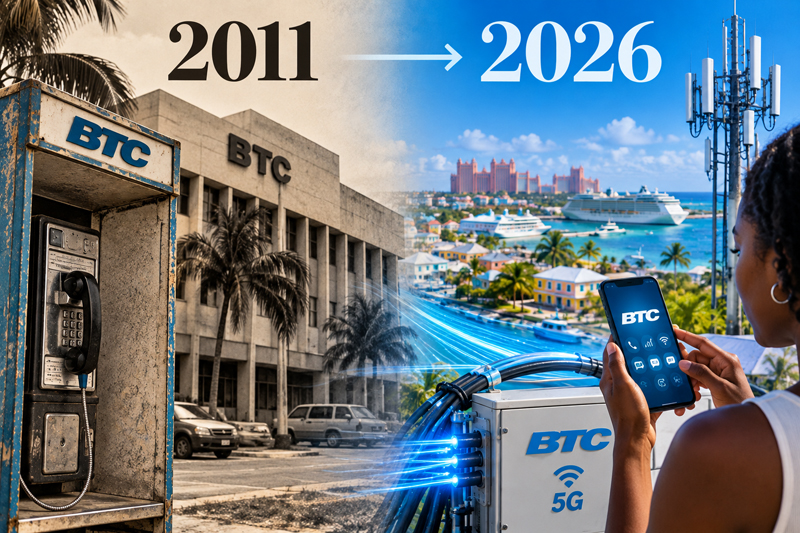
Go Back to 2011
The fascinating thing about rereading the statements surrounding the BTC sale is how specific they were.
Privatisation was supposed to deliver better telecommunications through the resources and expertise of a major international operator.
The Government’s communications policy called for greater efficiency, investment and innovation; sustainable competition; affordable access to high-quality communications throughout The Bahamas; and services offering consumers greater choice, quality and affordability.
But there were also tangible promises.
Bahamians were told to expect faster mobile data, wider availability of smartphones, faster broadband, better roaming, improved Family Island connectivity, better customer service, simpler billing and cheaper communications for businesses.
Inter-island mobile long-distance charges were to disappear.
And mobile rates were expected to fall by as much as 36 percent over three years, even before cellular competition arrived.
Cable & Wireless brought something BTC could not easily manufacture on its own: scale.
It operated across numerous countries. It could purchase equipment across a regional network, share technical expertise, deploy technology across multiple markets and spread development costs over a far larger customer base.
There was even an ambition for BTC to become something more than the Bahamian subsidiary of an international telecommunications company.
Cable & Wireless proposed making BTC one of three regional hubs alongside Jamaica and Barbados — a “centre of excellence” capable of providing certain call-centre, network and technical services to other companies within the group.
The promise wasn’t merely that BTC would become smaller and more efficient.
It was that BTC could become better.
Some of the Promises Clearly Happened
Any fair retrospective has to acknowledge that much of the telecommunications world envisioned in 2011 actually arrived.
Inter-island mobile roaming charges disappeared shortly after privatisation.
Mobile broadband became faster.
Smartphones became ubiquitous.
Data became vastly more important than voice calls.
Broadband speeds increased dramatically.
BTC’s network has continued evolving, and today the company offers technologies and services that would have seemed extraordinary to the average Bahamian telephone customer in 2011.
BTC continues expanding broadband in the Family Islands. In 2026 the company identified Cat Island, Exuma and Andros for further deployment of its BTC Air fixed-wireless broadband service following expansion in Bimini and Eleuthera.
And perhaps most importantly, Bahamians eventually received something they had never previously had in cellular service:
a choice.
Then Came Aliv
For decades, if you wanted mobile telephone service in The Bahamas, there was BTC.
That changed in 2016.
Aliv entered the market as the country’s second mobile operator, ending BTC’s cellular monopoly.
The significance of that development shouldn’t be understated.
Competition had been one of the central objectives behind telecommunications reform from the beginning.
Consumers could finally compare networks, plans, data packages, promotions and customer service — and take their business elsewhere.
Six years after liberalisation, the Utilities Regulation and Competition Authority reached a remarkable conclusion.
In its 2022 mobile market review, URCA determined that neither BTC nor Aliv held a dominant market position.
The newcomer had captured enough of the market that regulatory restrictions originally designed to constrain BTC’s dominance were no longer considered necessary.
On the question of competition, therefore, the transformation is difficult to dispute.
The monopoly was broken.
That was one of the biggest promises of telecommunications reform, and it happened.
But Something Else Happened Too
BTC became much smaller.
Very quickly.
In May 2011 — barely two months after privatisation — BTC announced a voluntary separation programme intended to bring its cost structure closer to telecommunications industry standards.
The company estimated that as much as 30 percent of its workforce might leave.
Cable & Wireless later reported that more than 470 BTC employees had departed since July 2011.
That was just the beginning.
Restructuring and voluntary separation exercises would become recurring features of BTC’s post-privatisation history.
Today, union leaders estimate the company employs roughly 500 people.
And now they say another restructuring and voluntary separation exercise is being contemplated, potentially involving approximately 50 more employees.
From one perspective, this is exactly what privatisation was supposed to accomplish.
BTC was expected to become leaner and more efficient.
Telecommunications itself has also changed enormously. Digital switching, automation, online billing, self-service apps, fibre networks, cloud computing and increasingly artificial intelligence mean that modern telecommunications companies simply don’t require armies of people performing many of the functions telephone companies once did.
But there is another legitimate question.
At what point does becoming leaner stop being evidence of efficiency and start becoming evidence of contraction?
Seven CEOs in Fifteen Years
That question has become particularly relevant following the departure of Sameer Bhatti.
Bhatti stepped down as BTC’s chief executive in October after approximately four years in the position.
His departure means BTC is now searching for its seventh CEO since privatisation.
The post-2011 leadership list includes Geoff Houston, Leon Williams, Dexter Cartwright, Garfield “Garry” Sinclair, Andre Foster and Sameer Bhatti.
BTC must now find number seven.
Executive turnover alone doesn’t prove that a company is poorly managed. CEOs leave for many reasons, and telecommunications has undergone extraordinary disruption during this period.
Bhatti’s tenure was actually unusually stable by recent BTC standards.
During his four years, he says the company expanded fibre, introduced converged mobile offerings, deployed new fixed-wireless technology across multiple islands, advanced AI and customer-service capabilities, completed several years of audits and restored dividend payments.
Those are meaningful accomplishments.
But six departing chief executives in fifteen years inevitably raises questions about continuity, strategy and exactly what BTC is supposed to become.
And BTC Is Losing Revenue
There is another number worth watching.
According to Liberty Latin America’s latest reported results cited by Tribune Business, BTC’s revenue during the first six months of 2026 fell from $97.7 million to $85.8 million compared with the same period a year earlier.
That’s a decline of $11.9 million, or 12.2 percent.
Competition undoubtedly explains part of BTC’s very different position today.
That was inevitable.
You cannot simultaneously promise to end a monopoly and expect the former monopolist to retain all of its customers and revenue forever.
In fact, BTC losing market share is partly evidence that liberalisation worked.
But it makes another question increasingly important:
What is BTC’s long-term role in the Bahamian telecommunications market?
What Happened to the Bahamian 51 Percent?
Even the ownership story became more complicated after the original sale.
In 2014, following negotiations by the Christie administration, Cable & Wireless transferred two percent of BTC into the BTC Foundation.
That produced an unusual arrangement:
Government: 49 percent.
Cable & Wireless: 49 percent.
BTC Foundation: 2 percent.
The foundation’s shares were non-voting and intended to generate dividends supporting telecommunications access and other civic projects.
Cable & Wireless retained board and management control.
So Bahamians regained a 51 percent economic interest, but not operational control.
That distinction has remained important ever since.
Today Cable & Wireless has itself evolved into Liberty Caribbean, part of Liberty Latin America.
The company Bahamians sold control of BTC to in 2011 has therefore changed too.
The Most Important Promise May Have Been Competition
Looking back fifteen years later produces an interesting verdict — because the record isn’t neatly one-sided.
The telecommunications market unquestionably became more modern.
Technology improved.
Mobile data exploded.
Broadband improved.
New services appeared.
Family Island connectivity continues to expand.
And most significantly, the cellular monopoly disappeared.
Those are substantial achievements.
But the BTC of 2026 is also a company with a dramatically smaller workforce, declining recent revenues, repeated restructurings and another CEO search underway.
And the grander 2011 vision of BTC becoming a regional “centre of excellence” within the Cable & Wireless empire is considerably harder to identify today.
Perhaps that is partly because telecommunications itself changed faster than anyone anticipated.
In 2011, BlackBerry was still important enough to be specifically mentioned in the Government’s description of BTC’s technological future.
WhatsApp was barely two years old.
Instagram was months old.
Zoom did not exist.
TikTok did not exist.
5G did not exist commercially.
Most Bahamians still thought of a telephone company primarily as a company that sold telephone calls.
Today the telephone call may be one of the least interesting things travelling across a telecommunications network.
So, Did Privatisation Work?
The answer depends partly on what is being measured.
If the test is whether The Bahamas developed a competitive cellular market, the evidence is clear: it did.
If the test is whether Bahamians gained access to faster networks, modern mobile technology and a much wider range of communications services, they did.
If the test is whether BTC became leaner, it certainly did.
But if the test is whether BTC became the regional centre of excellence envisioned in 2011, whether repeated restructuring produced a stronger institution, whether six CEO departures in fifteen years represent the continuity expected from an international strategic partner, or whether today’s BTC occupies the commanding regional position once imagined for it, the answers are less obvious.
And perhaps that is precisely why the question is worth asking.
The argument over BTC has traditionally been framed as public versus private.
Maybe fifteen years later, that’s the wrong argument.
The better test is performance.
What did we have?
What were we promised?
What did we sell?
What did we receive?
And what do we have now?
Because in 2011, The Bahamas didn’t simply sell 51 percent of a telephone company for $210 million.
We bought a promise about what Bahamian telecommunications could become.
Fifteen years later, we have enough evidence to start checking the receipt.