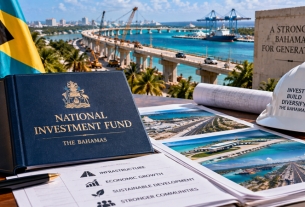
From the ambitious Freeport experiment to the latest $800 million resort announcement, Grand Bahama has repeatedly been promised a new era of prosperity. Yet the island continues to struggle with declining tourism infrastructure, business closures and economic uncertainty. Perhaps the question is no longer how much investment is being announced, but how much is actually reaching the people who live there.
By BahamasB2B
Grand Bahama has been waiting for its comeback for a very long time.
Long enough to have heard the promises before.
Another major hotel development.
Another international investor.
Another airport redevelopment.
Another cruise port.
Another ambitious announcement about thousands of jobs and billions of dollars in economic activity.
And another assurance that the island’s best days are just ahead.
Some of those investments have produced genuine results. Others have stalled, changed direction or failed to materialise.
Meanwhile, residents and business owners continue to ask a remarkably simple question.
When will the promised recovery finally reach us?
The question has become particularly relevant as Grand Bahama once again awaits progress on two projects widely considered essential to its economic future: the redevelopment of Grand Bahama International Airport and the revival of the Grand Lucayan resort.
Both have been the subjects of major investment announcements.
Both remain central to the island’s recovery plans.
And both illustrate the difference between announcing economic development and actually delivering it.
Freeport Was Once the Future
To understand Grand Bahama’s predicament, it helps to remember how extraordinary the original Freeport experiment was.
The modern development of Freeport began with the Hawksbill Creek Agreement of 1955.
The agreement created a distinctive economic arrangement intended to attract private investment, develop infrastructure and establish an industrial and commercial centre on Grand Bahama.
Through the Grand Bahama Port Authority and associated development arrangements, Freeport was envisioned as something quite different from the traditional Bahamian economy.
It would become an international industrial, shipping, commercial and tourism centre.
And for a time, the vision appeared to be working.
Freeport attracted major industrial operations, shipping facilities, hotels, residential developments and international businesses.
Its harbour became an important maritime asset.
Its airport offered substantial capacity for international aviation.
Hotels and golf courses helped establish the island as a major tourism destination.
For many Bahamians, Freeport represented opportunity.
There were jobs in construction, manufacturing, shipping, hotels, retail and professional services.
There was also a sense that Grand Bahama might develop into a genuine second economic centre for the country, reducing the nation’s overwhelming dependence on Nassau.
That ambition remains important today.
But the economic structure that supported Freeport’s early growth did not remain unchanged.
The Long Decline
Grand Bahama’s difficulties did not begin with a single hurricane, failed investment or government administration.
They developed over decades.
The island experienced changes in its industrial economy, increasing competition from other tourism destinations, the decline of certain traditional businesses and repeated disruptions to its hotel industry.
The closure or contraction of major tourism properties affected far more than hotel employees.
Restaurants lost customers.
Taxi drivers lost fares.
Retail shops lost foot traffic.
Tour operators lost bookings.
Property owners lost tenants.
And businesses that depended on a steady flow of visitors found themselves operating in an increasingly uncertain environment.
Then came the hurricanes.
Hurricane Frances and Hurricane Jeanne struck in 2004.
Hurricane Wilma followed in 2005.
Hurricane Matthew caused further devastation in 2016.
And in 2019, Hurricane Dorian inflicted catastrophic damage on Grand Bahama and Abaco.
Dorian was an extraordinary disaster, bringing prolonged storm surge, destructive winds and enormous damage to homes, infrastructure and businesses.
But it would be misleading to attribute Grand Bahama’s economic difficulties entirely to hurricanes.
Many of the island’s structural problems were already evident.
The storms compounded weaknesses that had developed over many years.
The Grand Lucayan Saga
Few properties illustrate Grand Bahama’s economic challenges more clearly than the Grand Lucayan resort.
For years, the property was one of the island’s most important tourism assets.
Its rooms, restaurants, golf facilities and surrounding businesses helped support a substantial network of employment and commercial activity.
But successive disruptions, including hurricane damage and changing ownership arrangements, left the resort struggling.
In 2018, the Government purchased the property for approximately $65 million.
The objective was to preserve a critical tourism asset and facilitate its eventual return to private ownership and operation.
What followed was a succession of negotiations, proposed transactions and redevelopment plans.
A proposed arrangement involving Royal Caribbean and the ITM Group did not reach the intended completion.
A subsequent deal involving Electra America Hospitality also failed to materialise.
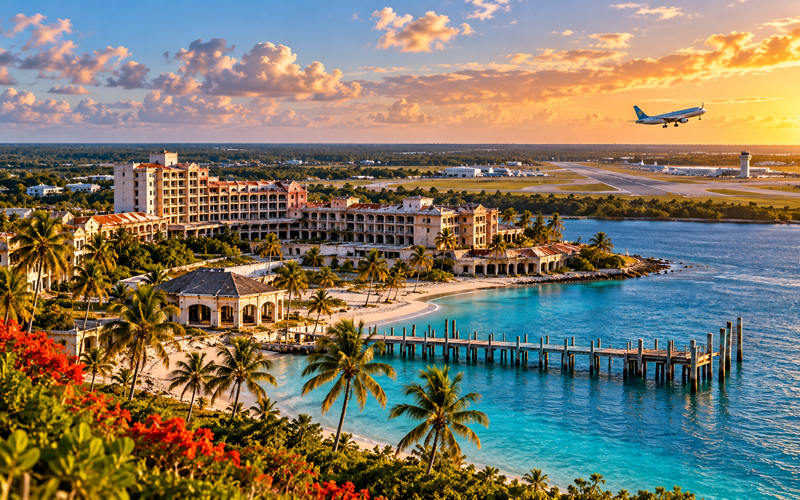
Then, in May 2025, the Government announced a new agreement with Concord Wilshire for an ambitious redevelopment reportedly involving approximately $827 million in investment.
The proposed project included hotels, entertainment facilities, a casino, marina infrastructure and other attractions.
The development was presented as an opportunity to transform the property into a major integrated tourism destination.
The plans were substantial.
But by October 2026, residents and business leaders were still demanding clearer information about the timetable and progress.
That does not necessarily mean the development will fail.
Large projects require financing, regulatory approvals, engineering, planning and complex commercial arrangements.
But after years of uncertainty, the public’s demand for measurable milestones is understandable.
Grand Bahama has seen enough announcements to know that a Heads of Agreement is not the same thing as a completed hotel.
An Airport Is More Than an Airport
Grand Bahama International Airport is another critical piece of the economic puzzle.
For an island seeking to rebuild its hotel industry, reliable international air access is indispensable.
Airports do not merely move passengers.
They determine which airlines can serve a destination, how conveniently visitors can arrive, how investors evaluate tourism projects and whether businesses can depend on a predictable flow of customers.
Following Hurricane Dorian, Grand Bahama’s airport infrastructure suffered significant damage.
Its redevelopment has been discussed repeatedly.
The Government has announced plans involving more than $100 million in initial investment, and officials have reported progress on preparatory work.
But residents and business leaders continue to demand a firm completion schedule and clarity about the facilities that will ultimately be delivered.
That uncertainty has wider economic consequences.
A developer considering a major hotel needs confidence that visitors will be able to reach it.
Airlines need confidence in passenger demand and airport facilities.
Restaurants and retailers need confidence that hotel occupancy will support their businesses.
And workers need confidence that jobs created during construction will lead to sustainable long-term employment.
These elements depend on one another.
An airport without sufficient hotels may struggle to attract air service.
Hotels without reliable air service may struggle to fill their rooms.
And local businesses without either may struggle to survive.
That is why Grand Bahama’s recovery cannot be measured through isolated projects alone.
The Cruise Ship Paradox
Grand Bahama has also received major investment in cruise tourism.
Carnival’s Celebration Key development represents a significant commitment to the island and has brought new activity to the destination.
But cruise tourism creates a different economic model from traditional stopover tourism.
A hotel guest may spend several nights on the island, visiting restaurants, shops, attractions and other local businesses.
A cruise passenger may remain for only a few hours.
And when a cruise line operates its own purpose-built destination, a substantial portion of passenger spending may occur within facilities controlled by the cruise company.
That does not mean cruise investment provides no benefit.
It can generate employment, supplier contracts, transportation opportunities, taxes and other economic activity.
But it raises a question about how widely those benefits circulate.
In October, Grand Bahama business leaders warned that the arrival of cruise passengers had not necessarily translated into the customer traffic local merchants expected.
At Port Lucaya Marketplace, businesses have continued to struggle.
The temporary closure of Agave Restaurant affected approximately 40 workers and prompted renewed concern about the area’s commercial future.
The Grand Bahama Chamber of Commerce warned that some businesses were operating under severe pressure.
The issue is not simply how many visitors arrive in Grand Bahama.
It is where they go, how long they stay and how much money they spend with independently owned Bahamian businesses.
A million visitors who never leave a self-contained destination do not create the same economic opportunities as a million visitors circulating throughout the island.
What Do Grand Bahama Businesses Actually Need?
The Grand Bahama Chamber of Commerce has provided an unusually useful answer.
In its 2026 business climate survey, conducted between June 15 and August 4, the Chamber questioned 114 companies representing 2,985 employees.
The results reveal the priorities of businesses operating on the island.
Airport redevelopment was selected by 82.5 percent of respondents as one of Grand Bahama’s five most important priorities for the next five years.
The Grand Lucayan redevelopment was selected by 51.8 percent.
Nearly half identified increased hotel, resort and vacation-rental capacity as something that would benefit their businesses.
And 62.8 percent identified the cost of doing business as their leading current obstacle.
These figures are revealing.
Businesses are not simply asking for more announcements.
They are identifying the practical conditions required to operate successfully.
Transportation.
Hotel capacity.
Affordable utilities.
Reliable infrastructure.
Customers.
And confidence that the island’s major development plans will actually be completed.
Interestingly, 62.5 percent of the surveyed businesses still expected to grow over the following twelve months.
That suggests economic optimism has not disappeared.
But optimism alone cannot pay employees, purchase inventory or finance expansion.
The Cost of Waiting
Economic uncertainty has a cost that rarely appears in development announcements.
A restaurant owner who delays expansion because hotel redevelopment remains uncertain is making a real economic decision.
A young professional who leaves Grand Bahama because suitable employment is unavailable represents a loss of talent.
A skilled tradesperson who cannot find consistent work may relocate.
A property owner who cannot attract a tenant may postpone maintenance.
And a business that closes while waiting for promised visitor traffic may never reopen.
Over time, those individual decisions can weaken the very economic ecosystem that future investors hope to enter.
A new resort needs trained workers.
It needs restaurants, transportation companies, maintenance contractors, food suppliers, entertainers and professional services.
If too many of those businesses disappear during the years of waiting, rebuilding the local economy becomes more difficult.
That is why the timing of investment matters.
An $800 million development completed several years from now may be enormously valuable.
But it cannot immediately replace the income lost by a small business that closes today.
Grand Bahama Needs a Connected Strategy
Perhaps the most important lesson from Grand Bahama’s history is that individual megaprojects cannot carry an entire economy.
A functioning tourism destination requires an integrated system.
Airports must connect with hotels.
Hotels must connect with restaurants, shops and attractions.
Cruise facilities must provide meaningful opportunities for local entrepreneurs.
Industrial development must connect with workforce training.
Infrastructure must support private investment.
And the benefits of growth must reach communities beyond the boundaries of individual developments.
Grand Bahama already possesses substantial advantages.
It has geographic proximity to Florida.
It has an established deep-water harbour.
It has industrial infrastructure, experienced workers, beaches, marinas and considerable undeveloped potential.
It also has a history of entrepreneurship and international commerce.
The challenge is not a complete absence of economic assets.
It is finding a way to connect those assets into a durable, diversified economy.
Thirty Years of Announcements. What Should Come Next?
There is nothing inherently wrong with announcing major investments.
Governments need to attract capital.
Developers need to explain their plans.
Communities need reasons for confidence.
But after decades of economic difficulty, Grand Bahama deserves a more measurable conversation about development.
For every major project, the public should be able to determine:
When is financing secured?
When will construction begin?
What milestones have been completed?
How many permanent jobs will be created?
How many Bahamian businesses will participate?
When will the project begin operating?
And how will its economic benefits extend beyond the development itself?
These are not unreasonable demands.
They are ordinary questions that investors, lenders and business partners ask every day.
Grand Bahama residents should be entitled to similarly clear information about projects presented as essential to their economic future.
The Comeback Has to Be More Than a Headline
The story of Grand Bahama is not simply one of decline.
It is also a story of resilience, considerable economic potential and generations of Bahamians who have continued to build businesses and communities despite repeated setbacks.
There are investments underway.
There are entrepreneurs who remain optimistic.
And there are opportunities in tourism, logistics, manufacturing, maritime services, technology and other industries.
But the island’s recovery cannot be declared complete through an investment total or another ceremonial signing.
It must become visible in functioning hotels, reliable air service, busy restaurants, growing businesses, stable employment and renewed confidence among residents.
Freeport was once promoted as an extraordinary experiment in economic development.
Seventy-one years after the Hawksbill Creek Agreement, that experiment is still evolving.
The question is whether the next chapter will finally translate the island’s considerable potential into sustained prosperity.
Grand Bahama does not need another promise that its future will be bright.
It needs enough completed projects, operating businesses and real jobs to make that future visible.