NASSAU, The Bahamas — Somewhere between government borrowing, public infrastructure and a relatively new institution called the National Investment Fund lies a $700 million question.
And it deserves explanation rather than political shouting.
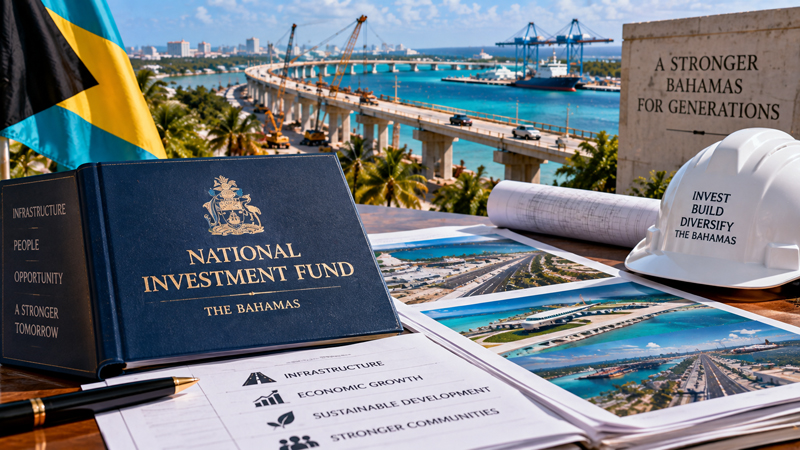
The NIF isn’t simply a government bank account dreamed up during the latest controversy. Parliament passed the National Investment Funds Act in 2022, replacing the former Sovereign Wealth Fund legislation. The law provides for funds and sub-funds intended to support national development, including infrastructure and public-improvement projects and the blue and orange economies.
The concept is appealing: use public assets and capital strategically to build things that strengthen the country over the long term.
Government documents have also described the intended NIF as an independently governed fund holding assets in trust for the Bahamian people, with governance modeled on internationally recognized Santiago Principles emphasizing transparency, accountability and prudent investment.
But implementation has become controversial.
Finance Minister Michael Halkitis disclosed during the May Budget communication that approximately $700 million in excess borrowing was transferred to the National Investment Fund rather than being used to finance the fiscal deficit. Opposition leader Michael Pintard subsequently pointed to an apparently conflicting statement from the Prime Minister’s communications director saying the $700 million had “nothing to do with” the NIF.
There is an important distinction here.
The Government says approximately $310.9 million has actually been invested or spent through the NIF mechanism, including $210.6 million on buildings and roads and $100.3 million on aviation infrastructure. Halkitis has defended those investments as legitimate public purposes.
The controversy therefore isn’t simply, “Where did $700 million go?”
The better questions are:
What money entered the NIF structure? Under what parliamentary authority? What has actually been spent? What remains? Who approved those expenditures? And who was responsible for overseeing the fund while its permanent governance structure was incomplete?
Those last questions matter because Halkitis acknowledged this month that the NIF’s governance arrangements remain a work in progress, even after almost $311 million in public money had been deployed. He told Parliament that regulations and committee structures are still being completed, while maintaining that the Ministry of Finance operated under existing public-finance law during the interim period.
There is also documentary evidence that Parliament authorized borrowing specifically connected with the NIF. A 2024-25 parliamentary resolution authorized $300 million in additional borrowing for national development and infrastructure and explicitly referred to depositing those borrowed funds into the National Investment Fund.
So this is not best understood as a mystery account containing $700 million.
It is a much more consequential question about how The Bahamas intends to invest borrowed public money outside the traditional annual-budget process while maintaining parliamentary oversight and public accountability.
A National Investment Fund could become an important tool for building airports, roads and other infrastructure the country badly needs.
But an investment fund intended to exist for generations requires something equally valuable:
public confidence in how the money gets there, who controls it and where it goes.
That may ultimately be the real $700 million question.
BahamasB2B Explainer | September 2026