University of The Bahamas researchers have discovered extraordinarily high concentrations of a toxic heavy metal in mangrove sediments on Grand Bahama. The findings raise serious environmental questions, but perhaps the most troubling discovery is how little we know about where the contamination came from — or how long it has been there.
By BahamasB2B
Grand Bahama’s mangroves may be telling us something important about the island’s environment.
And what they are telling us is troubling.
Researchers from the University of The Bahamas have discovered unusually high concentrations of cadmium, a toxic heavy metal, in mangrove sediments collected from East Grand Bahama.
At some locations, the reported concentrations were extraordinarily elevated.
Across the East Grand Bahama sampling sites, researchers found an average cadmium concentration of 442.58 milligrams per kilogram of sediment.
The reference value used in their analysis was just 0.6 milligrams per kilogram.
That places the reported average at approximately 738 times the reference level.
The findings, reported on October 9, are expected to appear in Volume 32 of the International Journal of Bahamian Studies, with a public presentation scheduled for October 20.
The research raises questions about possible ecological damage, human exposure and the adequacy of environmental monitoring.
But it also raises a broader question that Grand Bahama has confronted repeatedly throughout its history.
What are the environmental costs of economic development, and are we doing enough to measure them?
What the Scientists Found
The study was conducted by University of The Bahamas researchers Antonio Cadet, Veronica Toppin, Tamia Hamilton, Carlton Watson and Williamson Gustave.
The team collected 48 sediment samples from 12 locations in Dover Sound and East Grand Bahama.
Samples were taken from the upper 20 centimetres of mangrove sediment and analysed at the university’s Soil and Complex Matrix Laboratory.
The researchers examined concentrations of heavy metals and evaluated potential ecological and human health risks.
The results were striking.
In East Grand Bahama, average cadmium concentrations reached 442.58 milligrams per kilogram.
In Dover Sound, the reported average was 25.64 milligrams per kilogram, although cadmium was undetectable at three of the five sampling locations there.
The researchers also identified elevated concentrations of other metals, including antimony and copper at certain locations.
The most concerning results came from East Grand Bahama.
Three sampling locations were identified as particularly problematic, prompting recommendations for further investigation and consideration of public health precautions.
But the researchers did not establish that residents had become ill because of the contamination.
Nor did the study identify a definitive source.
Those distinctions are critically important.
What Is Cadmium, and Why Does It Matter?
Cadmium is a naturally occurring heavy metal that can also enter the environment through industrial processes, waste disposal and certain manufactured products.
It has been used in batteries, pigments, metal coatings and other industrial applications.
Cadmium can persist in the environment for long periods.
Unlike many organic pollutants, metals do not simply break down and disappear.
Depending on environmental conditions, they may remain in sediments, move through water or become available to living organisms.
Long-term cadmium exposure has been associated with kidney damage, bone disease and certain cancers.
The International Agency for Research on Cancer classifies cadmium and cadmium compounds as carcinogenic to humans.
But identifying cadmium in sediment is not the same thing as demonstrating that people have been exposed to harmful doses.
Actual risk depends on how the material is encountered, how much enters the body, how often exposure occurs and for how long.
Those are questions that require additional investigation.
Why Mangroves Matter
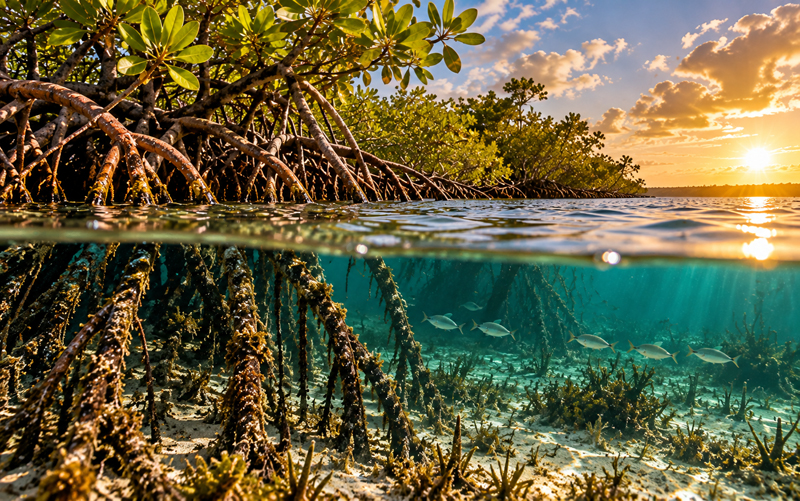
Mangroves are among the most valuable ecosystems in The Bahamas.
They provide nursery habitats for fish and other marine life.
They support biodiversity.
They help stabilise shorelines.
And they can reduce some of the impacts of coastal erosion and storm surge.
Mangroves also have another important characteristic.
They trap sediment.
As water moves through mangrove environments, suspended particles settle among the roots and accumulate in the surrounding mud.
Pollutants attached to those particles can accumulate as well.
That makes mangrove sediment a useful indicator of environmental contamination.
It can provide evidence of materials entering coastal ecosystems over time.
But it also means that mangroves can become repositories for pollutants that may persist for years.
The discovery of elevated cadmium concentrations therefore raises concerns extending beyond the sediment itself.
Could the contamination affect marine organisms?
Could it enter local food webs?
Might fish, crabs or other seafood species accumulate some of these metals?
The present study did not test seafood.
Those questions remain unanswered.
And until they are investigated, it would be premature either to declare local seafood unsafe or to assume there is no risk.
The Unexpected Geography of the Findings
One of the most interesting aspects of the research is where the highest concentrations were discovered.
Grand Bahama has a substantial industrial history.
Freeport has long supported shipping, manufacturing, energy-related operations, waste-handling activities and other industries.
It might therefore seem reasonable to expect the highest contamination near established industrial facilities.
But that is not what the researchers found.
Dover Sound, located near industrial and waste-handling activities, recorded elevated cadmium at some sites.
Yet East Grand Bahama, a less industrialised area, recorded much higher average concentrations.
That unexpected result complicates any simple explanation.
It also makes the question of contamination sources especially important.
The findings cannot automatically be attributed to a particular industrial company, development project or waste facility.
Environmental contaminants can travel.
They may be transported by stormwater, flooding, coastal currents, airborne particles or the movement of contaminated materials.
And some metals can occur naturally in soils and sediments.
The task now is to determine which processes could explain the concentrations observed.
Could Hurricane Dorian Have Played a Role?
The researchers identified Hurricane Dorian as one possible factor requiring investigation.
In September 2019, Dorian devastated Grand Bahama and Abaco.
Its prolonged storm surge inundated large areas, damaged infrastructure and redistributed enormous quantities of water, sediment and debris.
Such events can move contaminants from one location to another.
Floodwaters may pass through industrial sites, waste-disposal areas, roads, buildings and other developed environments before reaching wetlands and coastal waters.
Sediments deposited by storms can contain material transported from distant locations.
It is therefore possible that a major storm could contribute to the redistribution of heavy metals.
But possible is not the same as proven.
The researchers did not have comparable sediment measurements taken before Dorian.
Without those baseline measurements, it is not possible to establish whether the hurricane caused, increased or merely redistributed the contamination.
That uncertainty points toward a much larger national problem.
If we do not measure environmental conditions before a disaster, how can we accurately determine what the disaster changed?
The Problem With Not Knowing
The Bahamas has invested enormous resources in economic development.
We conduct feasibility studies for hotels.
We assess the commercial potential of cruise ports.
We estimate the number of jobs major projects may create.
We calculate projected visitor arrivals, investment totals and government revenue.
But how consistently do we measure the environmental conditions that exist before development begins?
And how effectively do we monitor those conditions afterward?
Without reliable baseline data, determining responsibility for environmental contamination becomes considerably more difficult.
Suppose heavy metals are discovered near an industrial or commercial development.
Were they present before the project began?
Did they arrive through natural processes?
Were they deposited by a hurricane?
Did they originate from historical waste disposal?
Or are they associated with current activities?
Without adequate records, those questions may be impossible to answer confidently.
The absence of information can create problems for everyone.
Communities may fear risks that have not been properly assessed.
Businesses may face suspicion without evidence establishing responsibility.
Regulators may struggle to determine appropriate remedial action.
And environmental damage, if present, may continue without its source being identified.
A Reference Level Is Not a Safety Limit
There is another important detail in the University of The Bahamas findings.
The 0.6 milligram-per-kilogram value used for comparison was a reference concentration derived from Cuban soils.
It was not a Bahamian legal limit for cadmium in mangrove sediment.
Nor should the reported 738-fold comparison be interpreted as meaning that residents face 738 times an established safe level of human exposure.
The reference value helps researchers assess how unusually enriched the sediment may be.
It does not, by itself, establish a person’s health risk.
The researchers noted that Bahamian carbonate sediments differ from the soils used to develop the comparison values.
That creates additional uncertainty and demonstrates the importance of developing environmental reference values specifically suited to Bahamian conditions.
The Bahamas is a distinctive geological environment.
Its limestone islands, carbonate sediments, coastal wetlands and marine ecosystems do not necessarily behave like those in other countries.
Imported scientific standards can provide useful starting points.
But national environmental policy ultimately requires reliable local evidence.
What About the Cancer Risk?
The study also included screening calculations intended to estimate possible human health risks.
Using methods developed by the United States Environmental Protection Agency, the researchers examined hypothetical exposure pathways involving accidental ingestion of sediment, inhalation of particles and contact with the skin.
The calculations indicated potential concerns, particularly for children.
However, these were screening-level estimates based on assumed exposure conditions.
They were not measurements of actual cadmium intake among Grand Bahama residents.
They were not medical examinations.
And they did not establish that any particular cancer or illness had been caused by the contaminated sediment.
That does not make the findings unimportant.
Screening assessments are designed to identify situations that warrant closer investigation.
The results provide a reason to examine actual exposure conditions, particularly at the locations with the highest concentrations.
But public discussion should distinguish carefully between a potential hazard, an estimated exposure risk and a demonstrated health effect.
Confusing those categories can either generate unnecessary alarm or lead to legitimate concerns being dismissed.
Neither outcome serves the public.
The Environmental Legacy of Development
Grand Bahama’s industrial history is an important part of its identity.
The development of Freeport created employment, infrastructure and economic opportunities that helped transform the island.
The harbour, industrial sector and associated businesses have contributed significantly to the national economy.
Industrial activity is not inherently incompatible with environmental protection.
But it requires appropriate monitoring, waste management, enforcement and long-term accountability.
The environmental consequences of economic activity may not always be visible when a project is operating.
Some contaminants accumulate gradually.
Others remain in soils and sediments long after a particular activity has ended.
And natural disasters can complicate the situation by moving materials across large areas.
The result is that environmental management must extend beyond the initial approval of a development.
It must include monitoring during operations, appropriate closure or remediation procedures, and continued assessment where long-lived contaminants may remain.
That is particularly important for islands where communities, industrial facilities, wetlands and coastal fisheries exist in close proximity.
Who Is Responsible for Finding the Answers?
The University of The Bahamas research demonstrates the importance of domestic scientific capability.
The researchers have identified a potentially significant environmental problem.
But their work should be regarded as the beginning of an investigation, not its conclusion.
Several questions now require attention.
Where exactly are the most contaminated locations?
How extensive is the contamination beyond the sampled sites?
Are the concentrations consistent across different sediment depths?
What are the likely sources?
Are nearby waters or marine organisms affected?
Do residents regularly encounter the contaminated sediment?
And what practical precautions, if any, are warranted while further investigation proceeds?
Answering those questions will require cooperation among researchers, environmental authorities, public health officials and potentially other agencies.
It may also require additional funding and laboratory capacity.
The study’s findings should be independently examined and followed by appropriately designed sampling programmes.
If significant contamination is confirmed, authorities will need to determine whether containment, remediation, access restrictions or other measures are justified.
Those decisions should be based on evidence and communicated clearly to affected communities.
A National Research Opportunity
There is a wider lesson here.
The Bahamas cannot effectively manage its environment using only occasional studies conducted after concerns arise.
It needs sustained scientific monitoring.
That includes reliable information about water quality, coastal sediments, industrial pollutants, fisheries, groundwater and other environmental conditions.
Such information has economic value.
It helps protect tourism.
It supports fisheries.
It provides certainty for responsible investors.
It allows regulators to make better decisions.
And it gives communities confidence that potential hazards are being assessed systematically rather than reactively.
The University of The Bahamas researchers have provided a useful example of the role local scientific institutions can play.
Their findings should encourage additional research, including the development of reference values appropriate to Bahamian geology and ecosystems.
The research also illustrates why environmental protection and economic development should not be treated as opposing objectives.
A country that depends heavily on the quality of its natural environment has a direct economic interest in understanding and protecting it.
The October 20 Presentation
The study is scheduled to appear in Volume 32 of the International Journal of Bahamian Studies.
Researchers are expected to present their findings on Tuesday, October 20, at 2 p.m. in the Harry C. Moore Library auditorium at the University of The Bahamas.
The event is open to the public.
It offers an opportunity for scientists, policymakers, journalists and concerned citizens to examine the research in greater detail.
The questions should be specific.
What additional testing is needed?
Have relevant government agencies been notified?
Are there plans to sample seafood, water or additional sediment locations?
Can the sources of contamination be investigated?
And what resources are available for continued monitoring?
The answers may determine whether this study becomes an isolated academic finding or the beginning of a sustained national environmental investigation.
The Real Cost of Not Knowing
Grand Bahama has spent decades pursuing economic development.
It has welcomed industrial investment, tourism projects, maritime activity and major infrastructure.
Those investments have created opportunities and helped shape the island’s economy.
But the discovery of unusually high cadmium concentrations in mangrove sediments raises a question that cannot be answered by investment figures alone.
What environmental changes have occurred alongside that development?
At present, the researchers cannot say where the cadmium came from.
They cannot establish how long it has been accumulating.
And they cannot determine from this study whether people have suffered health effects because of it.
Those uncertainties are not reasons to ignore the findings.
They are reasons to investigate them.
Because responsible development requires more than measuring the money invested and the jobs created.
It also requires understanding what happens to the land, the water and the ecosystems on which future generations will depend.
The most troubling thing about Grand Bahama’s contaminated mangroves may not be what scientists have discovered.
It may be how much we still do not know.