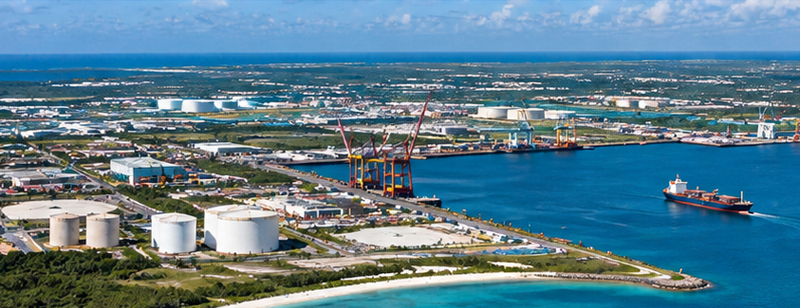
As the Government begins public consultation on the most far-reaching proposed changes to Freeport’s governance in generations, Grand Bahama Port Authority co-chair Sarah St George is urging caution. Seventy-one years after Wallace Groves negotiated the Hawksbill Creek Agreement, the question is no longer simply whether Freeport needs reform. It is who should control its future — and whether changing the system will finally deliver the prosperity Grand Bahama has been promised for decades.
By BahamasB2B | November 5, 2026
The battle over Freeport’s future has entered a new phase.
On November 1, the Government officially opened a six-month public consultation on proposals that could fundamentally alter the relationship between the Grand Bahama Port Authority, the Government of The Bahamas and the people of Grand Bahama.
At stake is the governance arrangement established under the Hawksbill Creek Agreement of 1955, one of the most consequential economic development agreements in Bahamian history.
As we examined in our recent retrospective, The End of Freeport as We Know It?, that agreement transformed a largely undeveloped stretch of Grand Bahama into an international industrial, maritime and commercial centre.
But it also created an unusual system in which a privately owned company exercised functions normally associated with government.
Seventy-one years later, the Davis administration believes that arrangement requires fundamental change.
The Port Authority’s owners are not convinced.
And the people who live and work in Freeport are now being asked to help determine what comes next.
Sarah St George Makes Her Case
Speaking at Freeport’s Icons of the City ceremony on October 30, Grand Bahama Port Authority co-chair Sarah St George defended the principles underlying the Hawksbill Creek Agreement while acknowledging that Freeport’s institutions are not perfect.
Her central argument was that Bahamian sovereignty and the Port Authority’s development model need not be mutually exclusive.
She cautioned against dismantling arrangements that have contributed to Freeport’s development without carefully considering what would replace them.
St George, whose family owns half of the Port Authority, urged a collaborative approach rather than one imposed through government intervention.
Her remarks reflected a concern shared by some Freeport residents and businesses: that replacing the Port Authority’s regulatory and administrative functions with central government control could introduce new uncertainties without necessarily improving services or attracting investment.
The Port Authority has argued that the Hawksbill Creek framework helped create Freeport’s deep-water harbour, industrial infrastructure, commercial facilities and distinctive investment environment.
Its supporters also point to the city’s planning, infrastructure and municipal services as examples of what the existing model has accomplished.
But even St George acknowledged that Freeport has not achieved everything its founders envisioned.
That admission matters.
Freeport’s original ambitions were extraordinary.
Its economic performance over recent decades has been considerably less so.
The Government Sees a Different Problem
Prime Minister Philip Davis has framed the proposed reforms as an effort to establish a single, accountable governance system for the entire island of Grand Bahama.
Under the existing arrangement, businesses within the Port Area operate under a distinct system of licences, approvals and concessions.
Communities outside that area do not enjoy the same framework.
The Government argues that this division has contributed to uneven development between Freeport and settlements in East and West Grand Bahama.
Its Green Paper, Grand Bahama: A Framework for Stability and Growth, proposes a comprehensive review of the Hawksbill Creek Agreement, a new Grand Bahama Development Act and a Government-led Development Council to coordinate economic development across the island.
It also raises the possibility of extending investment concessions beyond the Port Area.
The administration maintains that existing lawful rights and obligations will be respected and that changes will be pursued through the legislative process.
But the Government’s intentions are unmistakable.
It wants to replace the current division of public governance with a framework accountable to the Bahamian state.
The challenge will be demonstrating that the proposed alternative can perform those responsibilities more effectively.
The Problem Neither Side Can Ignore
Both the Government and the Port Authority can point to legitimate considerations.
The Hawksbill Creek Agreement helped create one of the country’s most important industrial and maritime centres.
Its investment incentives and development framework attracted enterprises that might otherwise have located elsewhere.
But Grand Bahama has also endured decades of economic disappointment.
The island’s stopover tourism industry has declined dramatically from its mid-1990s peak.
The Government’s Green Paper notes that more than half a million visitors stayed overnight on Grand Bahama in 1995, compared with approximately 100,000 in 2025.
The island’s population also declined between the 2010 and 2022 censuses.
Hurricanes, changing tourism markets, international competition and the COVID-19 pandemic have all contributed to its difficulties.
It would be simplistic to attribute those problems entirely to the Port Authority.
It would be equally simplistic to argue that an arrangement created in 1955 must remain substantially unchanged because it once produced remarkable results.
The real question is which governance structure can best serve the island’s present needs.
Who Will Actually Run Freeport?
This may be the most important practical question in the entire debate.
If the Port Authority’s public administrative functions are transferred or reorganised, who will assume responsibility for planning approvals, business licensing, roads, drainage, sanitation and other essential services?
Will those responsibilities rest with government ministries in Nassau?
Will they be administered locally?
What powers and resources will the proposed Grand Bahama Development Council possess?
And how will businesses and residents obtain timely decisions when problems arise?
Freeport’s economic future depends on more than tax incentives.
Investors need predictable rules, efficient administration, reliable infrastructure and confidence that decisions will not become entangled in bureaucratic delays.
Residents need functioning services and clear accountability.
A new governance structure that improves transparency but weakens administrative efficiency would hardly represent progress.
Conversely, retaining an efficient administrative system without sufficient public accountability would leave another important problem unresolved.
The objective should be to achieve both.
A Consultation Worth Taking Seriously
The Government has invited residents, businesses, licensees and community organisations to respond to 25 questions contained in its Green Paper.
Public meetings are planned for Freeport, East Grand Bahama and West Grand Bahama.
The consultation runs through April 30, 2027.
A White Paper setting out the Government’s decisions is targeted for July 1, 2027, with draft legislation expected by the end of that year and parliamentary consideration during the first quarter of 2028.
Those are proposed milestones, not guarantees.
Importantly, the Green Paper does not itself alter the existing legal rights of residents, businesses or Port Authority licensees.
The Government has committed to considering public submissions before finalising the legislative framework.
That commitment should be taken seriously by everyone involved.
The Port Authority has an opportunity to present a detailed case for retaining the elements of the Hawksbill Creek model that continue to serve Freeport well.
The Government has an obligation to explain how its proposed arrangements would improve accountability, investment and public services.
And Grand Bahama’s residents should have an opportunity to challenge the assumptions of both.
Beyond the Battle for Control
There is a danger that the Freeport debate will become a contest between two powerful institutions.
On one side stands the Government, asserting its responsibility for public administration and national development.
On the other stands the Port Authority, defending a contractual framework that has shaped Freeport for more than seven decades.
But neither institution should be the ultimate focus of the discussion.
That distinction belongs to the people of Grand Bahama.
For them, the questions are considerably more immediate.
Will businesses find it easier to operate?
Will investment increase?
Will young people find better employment opportunities?
Will infrastructure improve?
Will the tourism industry recover?
Will communities outside Freeport finally share more fully in the island’s economic development?
And will those responsible for delivering these improvements be answerable when they fail?
Those are the standards against which any new arrangement should be measured.
The Hawksbill Creek Agreement was an extraordinary experiment in economic development.
It deserves recognition for what it accomplished.
It also deserves scrutiny for what it has not accomplished.
The Government’s proposed reforms deserve equally careful examination.
Changing a governance structure is not, by itself, an economic development strategy.
The Bahamas must ensure that any replacement preserves the investment advantages that made Freeport attractive while addressing the shortcomings that have limited Grand Bahama’s progress.
Freeport’s future should not be determined simply by who wins the argument over the Hawksbill Creek Agreement.
It should be determined by which arrangement offers Grand Bahamians the greatest opportunity for prosperity, effective services and accountable government.
Seventy-one years after Wallace Groves envisioned a new city rising from the pine barrens of Grand Bahama, that remains the promise worth pursuing.