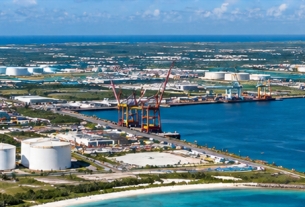
In 1955, a remarkable agreement between the colonial government and an American entrepreneur transformed a stretch of Grand Bahama pine forest into one of the Caribbean’s most ambitious experiments in private-sector development. Now, 71 years later, the Bahamian Government proposes to fundamentally change the arrangement that created Freeport. The question is whether a new system of governance can finally deliver the economic prosperity that the original experiment promised.
By BahamasB2B
In 1955, an American businessman named Wallace Groves entered into an agreement with the colonial government of The Bahamas that would change the course of the country’s economic history.
The Hawksbill Creek Agreement gave Groves and his development company extraordinary opportunities to transform a largely undeveloped section of Grand Bahama into a modern industrial, commercial and residential centre.
The arrangement was unprecedented in the Bahamian context.
A private company would undertake responsibilities ordinarily associated with government, including substantial elements of infrastructure development, planning and administration.
In exchange, it would receive extensive concessions designed to attract international investment.
From that agreement emerged Freeport.
Over the following decades, the city would become home to one of the Caribbean’s most important deep-water harbours, major industrial operations, international hotels, residential communities and an ambitious tourism industry.
For a time, Freeport appeared capable of becoming the economic counterpart to Nassau.
But the extraordinary arrangement that made its development possible has also remained a source of controversy.
And now, 71 years after it was signed, the Government of The Bahamas is proposing to fundamentally change it.
On October 21, Prime Minister Philip Davis announced plans for a new governance and development framework for Grand Bahama.
The proposed reforms would substantially alter the Grand Bahama Port Authority’s role in administering Freeport, review the Hawksbill Creek Agreement and establish new legislation governing economic development across the island.
The Government argues that the existing system has failed to deliver its full promise.
The Port Authority maintains that the rights established under the agreement must be respected and that changes should be achieved through consultation and cooperation.
Investors are concerned about legal certainty.
Residents are concerned about economic opportunity.
And Freeport finds itself confronting perhaps the most consequential question in its modern history.
Was the Hawksbill Creek experiment ultimately a success, a failure, or an extraordinary idea that simply failed to evolve with the times?
The Man Who Built a City
Wallace Groves was an American financier and entrepreneur who recognised Grand Bahama’s potential long before it became a major centre of international commerce.
Its proximity to Florida, extensive coastline, deep-water harbour possibilities and substantial undeveloped land offered opportunities that were difficult to replicate elsewhere in the Caribbean.
But developing that potential would require enormous investment.
Roads had to be constructed.
Harbour facilities had to be created.
Electricity, water, communications and other essential infrastructure had to be established.
And businesses needed compelling reasons to locate in what was then a relatively isolated part of the Bahamian archipelago.
The Hawksbill Creek Agreement provided those incentives.
Signed in August 1955, it established a framework through which the Grand Bahama Port Authority would facilitate the development and administration of the Freeport area.
Tax concessions, licensing arrangements and other incentives were intended to encourage industrial and commercial investment.
The agreement ultimately provided for a 99-year term extending to 2054.
It represented a remarkable transfer of development responsibility to the private sector.
In effect, the colonial government had authorised a company to create a city.
And that company did.
When Freeport Was the Future
The early decades of Freeport’s development were characterised by considerable ambition.
The harbour became a significant international maritime facility.
Industrial operations established themselves on the island.
Tourism development expanded through hotels, resorts, golf courses and residential communities.
The city attracted foreign investment and created employment opportunities for Bahamians in construction, hospitality, shipping, manufacturing and professional services.
Its infrastructure distinguished it from many other communities in The Bahamas.
Freeport was not simply another tourism destination.
It was intended to be a diversified economic centre, combining international trade, industry, tourism and residential development.
That distinction was important.
The Bahamian economy was becoming increasingly dependent on Nassau and Paradise Island.
Freeport offered the possibility of a second major centre of economic activity, geographically positioned to take advantage of international commerce and the enormous nearby American market.
For many years, the city represented an optimistic vision of what private investment could accomplish.
But the model also contained an unusual contradiction.
Although Freeport was part of The Bahamas, substantial aspects of its development and administration were controlled by a private organisation rather than through the ordinary mechanisms of elected government.
That arrangement was accepted as part of the original development bargain.
Whether it remains appropriate in an independent Bahamas is now at the centre of the debate.
Independence Changed the Country
When the Hawksbill Creek Agreement was signed in 1955, The Bahamas was a British colony.
The country would not achieve independence until July 10, 1973.
The political and constitutional environment in which the agreement was negotiated was therefore fundamentally different from the one that exists today.
The original arrangement reflected a colonial-era approach to economic development, in which extensive concessions could be granted to private investors in exchange for infrastructure and commercial expansion.
But independence brought a new understanding of national sovereignty, public accountability and the responsibilities of government.
The question of how Freeport should be governed became more complicated.
The Port Authority retained important powers and obligations under the agreement.
The Government retained its sovereign authority.
And successive administrations had to navigate the relationship between the two.
The Hawksbill Creek Agreement was amended in 1960 and 1966, demonstrating that it was never entirely static.
Nevertheless, the basic structure survived.
The result was a distinctive form of administration that combined private development responsibilities with public regulatory functions.
It was a model that had few direct equivalents elsewhere in the country.
When the Economic Engine Began to Falter
Freeport’s early successes did not guarantee permanent prosperity.
Over time, the island experienced changes in international trade, industrial activity and tourism.
Major hotels closed or struggled.
Competition from other Caribbean destinations intensified.
And a succession of hurricanes inflicted enormous damage.
The closure of the Royal Oasis resort following Hurricane Frances in 2004 eliminated a major tourism operation and approximately 1,200 jobs.
Hurricane Matthew caused further damage in 2016.
Hurricane Dorian devastated Grand Bahama in 2019, compounding difficulties that had already accumulated over many years.
The Grand Lucayan resort became another symbol of the island’s struggle to restore its tourism industry.
Meanwhile, the island’s once-substantial stopover tourism business contracted dramatically.
According to figures included in the Government’s newly published Grand Bahama Green Paper, stopover visitors peaked at 587,250 in 1995.
By 2025, that number had fallen to 101,077.
That represents a decline of approximately 83 percent.
Even more revealing, the island’s 2025 stopover total was lower than its 2019 figure, before the pandemic.
Grand Bahama has continued to attract investment, particularly in maritime services and cruise tourism.
But the wider economy has struggled to generate the sustained growth that residents and businesses have been awaiting.
These difficulties provide the background to the Government’s latest proposals.
They do not, by themselves, establish that the Hawksbill Creek governance model caused the decline.
Hurricanes, airline capacity, hotel closures, international competition and changing tourism patterns have all played significant roles.
Determining the relative importance of those factors is essential to understanding whether changing Freeport’s governance will produce the economic results being promised.
The Government Proposes a New Beginning
On October 21, Prime Minister Philip Davis unveiled a Green Paper entitled Grand Bahama: A Framework for Stability and Growth.
The document proposes three major reforms.
First, a Grand Bahama Development Council would coordinate and monitor an island-wide economic development strategy.
Second, the Government would undertake a comprehensive review of the Hawksbill Creek Agreement, with the intention of establishing a successor framework.
Third, a new Grand Bahama Development Act would provide the legislative foundation for the revised arrangements.
The proposed approach would treat Freeport, East Grand Bahama, West Grand Bahama and the surrounding cays as interconnected parts of a single economy.
The Government argues that the existing framework has created unequal development opportunities because many of Freeport’s concessions apply specifically within the Port Area.
A new system could extend investment incentives more broadly across Grand Bahama, potentially including enhanced concessions for areas outside Freeport.
The Government also wants public regulatory and administrative functions to operate within a more transparent and accountable structure.
In his announcement, the Prime Minister made clear that maintaining the existing governance arrangement unchanged was not the Government’s intention.
But the precise structure of the proposed replacement remains subject to consultation.
That distinction matters.
The Green Paper is a policy proposal.
It is not legislation, and its publication has not itself changed existing licences, concessions or contractual rights.
The Port Authority Responds
The Grand Bahama Port Authority has responded cautiously.
In an October 22 statement, the organisation said it had received substantial information through the Prime Minister’s public announcement that had not been shared with it beforehand.
It welcomed the opportunity for constructive engagement but stressed the importance of respecting existing legal rights.
The Port Authority argues that the Hawksbill Creek Agreement was never intended to remain unchanged throughout its 99-year life.
It points to earlier amendments as evidence that the framework can evolve through cooperation between the Government and the Authority.
The organisation has also emphasised the importance of maintaining Freeport’s international competitiveness.
Its position is that any changes affecting existing rights should be negotiated and should demonstrate clear benefits for the people and businesses whose interests are involved.
This is more than an institutional disagreement.
The Port Authority has approximately 3,500 licensees operating under the existing framework.
Many have made investments on the basis of rights, concessions and obligations established under the agreement.
Those businesses need to understand what will happen to their existing arrangements.
The Port Authority’s owners also have substantial contractual and property interests.
Any restructuring will therefore involve complex legal, financial and commercial questions.
The Investment Confidence Question
The proposed reforms have also attracted attention beyond The Bahamas.
United States Ambassador Herschel Walker has publicly expressed concern about the implications for investor confidence.
His argument is that businesses making long-term investments need assurance that the legal arrangements governing those investments will remain predictable.
The concern is understandable.
A company considering a major industrial facility, resort or maritime operation may be committing capital that will take decades to recover.
Its investment decisions depend partly on the regulatory environment, taxation arrangements and legal protections available when the project begins.
Unexpected changes can affect the economics of those investments.
But there is another side to the argument.
Governments also have legitimate responsibilities to review regulatory structures, address economic inequalities and ensure that public functions are administered appropriately.
No economic development arrangement can reasonably be assumed to exist entirely outside the evolution of national policy.
The central issue is therefore not whether change is permissible.
It is how change is undertaken.
Will existing rights be respected?
Will investors have clear legal protections?
Will the new framework improve efficiency?
Will businesses face additional bureaucracy?
And will the proposed changes create greater certainty or simply replace one complicated system with another?
These questions deserve careful examination before legislation is enacted.
What About the People of Freeport?
Perhaps the most interesting aspect of the debate is that not everyone in Freeport opposes the proposed changes.
Grand Bahama attorney Thomas Dean has publicly supported the Government’s initiative, arguing that the existing arrangements have not delivered the economic results residents deserve.
He has questioned the accountability of an organisation exercising significant administrative responsibilities without being subject to the ordinary electoral process.
His position reflects a broader concern.
Residents can vote a government out of office.
They cannot vote the owners or directors of a private development authority out of office.
That difference becomes especially important when an organisation’s responsibilities extend beyond commercial development into functions that affect everyday life.
But replacing private administration with government administration does not automatically guarantee better performance.
Public agencies can also suffer from bureaucracy, inefficiency, political interference and inadequate resources.
The appropriate question is not simply whether Freeport should be governed by a private authority or the Government.
It is which responsibilities belong where, how decisions will be reviewed and how performance will be measured.
A modern framework could potentially combine effective public oversight with the commercial flexibility that helped make Freeport attractive in the first place.
Whether the proposed reforms achieve that balance remains to be seen.
The Danger of Replacing One Problem With Another
Freeport’s unusual governance arrangements have long been criticised.
But they have also provided advantages.
Businesses have benefited from a distinctive regulatory environment.
The Port Authority has played an important role in developing and maintaining infrastructure.
And Freeport’s international commercial identity has been built partly upon the predictability of its special arrangements.
Dismantling those arrangements without an effective replacement could create serious problems.
Investors may delay decisions while waiting to understand the new rules.
Existing businesses may face uncertainty about licences, fees, planning approvals and concessions.
Administrative responsibilities could become confused during the transition.
And disagreements over contractual rights could result in lengthy litigation.
The Government has attempted to address these concerns.
Its representatives have pledged that reforms will be implemented lawfully, that existing rights will be identified and considered, and that changes will not be applied retrospectively.
The Green Paper also proposes transitional provisions intended to preserve continuity of services and address existing permissions and obligations.
These assurances are important.
But their practical value will depend on the details of the eventual legislation and its implementation.
An Island Divided by Development
One of the more compelling arguments for reform concerns the relationship between Freeport and the rest of Grand Bahama.
The Hawksbill Creek Agreement created a special economic environment within a defined area.
That helped concentrate investment and infrastructure in Freeport.
But communities outside the Port Area did not necessarily receive the same advantages.
East Grand Bahama and West Grand Bahama have experienced their own economic difficulties, infrastructure challenges and limited opportunities.
The Government now proposes a more coordinated island-wide development strategy.
In principle, that is a reasonable objective.
But the economic differences between communities cannot necessarily be explained by the existence of the Hawksbill Creek Agreement alone.
Geography, population, transportation, infrastructure, tourism demand and commercial viability also influence where businesses invest.
The Government’s own Green Paper acknowledges limitations in the available economic data.
Some figures describe Grand Bahama as a whole without separately identifying Freeport’s contribution.
That makes it difficult to establish precisely how much of the island’s economic imbalance results from its governance arrangements.
Better information will be needed to evaluate whether the proposed reforms are likely to address the underlying problems.
What Would Success Actually Look Like?
Freeport’s future should not be judged solely by which institution holds regulatory authority.
It should be judged by economic results.
Will the new arrangements attract more investment?
Will businesses find it easier to obtain approvals?
Will infrastructure improve?
Will existing companies expand?
Will new industries develop?
Will more Bahamians find skilled, well-paid employment?
And will the benefits of development reach communities throughout Grand Bahama?
These are measurable questions.
A new governance structure should be accompanied by clear performance indicators and public reporting.
The Government’s proposed Grand Bahama Development Council could provide a mechanism for monitoring progress, provided its responsibilities and accountability are clearly defined.
But institutional reform alone cannot revive the island’s hotel industry, increase airlift, rebuild tourism infrastructure or guarantee new investment.
Those outcomes require financing, competent management, market demand and sustained implementation.
The most important test will be whether the proposed changes help those things happen.
A Historic Decision, but Not an Immediate One
The Government has established a timetable for consultation and reform.
Public consultation is scheduled to begin November 1, 2026, and continue through April 30, 2027.
A White Paper is expected by July 1, 2027.
Draft legislation is targeted for completion later in 2027, with parliamentary consideration planned for 2028.
That provides time for businesses, residents, investors and other stakeholders to examine the proposals.
It also creates an opportunity to address questions that have persisted for decades.
What is the appropriate role of the Grand Bahama Port Authority?
Which responsibilities should be exercised by public authorities?
How should existing concessions be protected?
Can investment incentives be extended throughout the island?
And what institutional arrangements would best encourage economic growth?
The consultation should not be treated as a formality.
The answers will shape the future of Freeport for generations.
Seventy-One Years Later
When Wallace Groves negotiated the Hawksbill Creek Agreement in 1955, he was attempting something extraordinary.
He wanted to create an international commercial and industrial city where little existed.
The project required substantial investment, unusual incentives and a willingness to experiment with a form of private-sector development that was far ahead of its time.
The result was Freeport.
Whatever criticisms may now be directed at the agreement or the institutions it created, the scale of that achievement should not be forgotten.
The harbour, industrial infrastructure, commercial facilities and residential communities remain substantial economic assets.
But neither should the city’s unrealised potential be ignored.
For too many years, Grand Bahama has struggled with economic stagnation, declining stopover tourism, business closures and uncertainty about its future.
The Hawksbill Creek Agreement was intended to create opportunity.
The question today is whether the framework that made Freeport possible is still capable of delivering it.
The Government believes fundamental change is necessary.
The Port Authority believes reform must respect existing agreements and preserve the advantages that attracted investment.
Residents and businesses have legitimate reasons to demand both accountability and economic certainty.
The challenge is to develop a system that achieves those objectives without sacrificing the commercial foundations upon which Freeport was built.
In 1955, The Bahamas made an extraordinary bargain to create a city.
Seventy-one years later, it must decide how that city should be governed — and how to ensure that its considerable potential finally delivers lasting prosperity for the people who call it home.