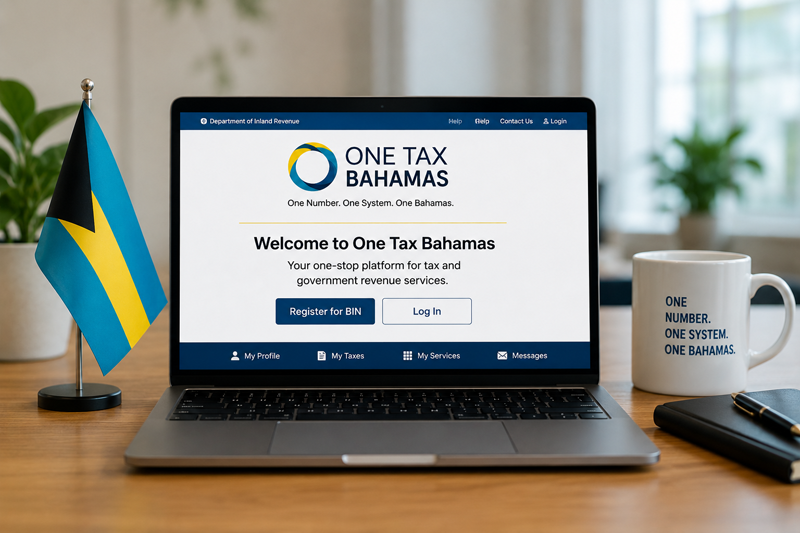
NASSAU, Bahamas — One Tax Bahamas launches today, Sept. 1, beginning a major change in the way Bahamian businesses and individuals will eventually register, file and manage their tax obligations.
For business owners, the most important thing to understand is also the simplest: One Tax Bahamas is not a new tax. It is a new system for administering taxes that already exist.
At the centre of that system is something businesses will quickly become familiar with — the Bahamas Identification Number, or BIN.
What is a BIN?
The BIN is a unique 10-digit identification number that will become the taxpayer’s identifier within the One Tax Bahamas system.
The Department of Inland Revenue says all taxpayers will need a BIN to access tax services through the new portal. Registration for BINs begins with today’s launch.
For businesses, think of it as the key that will eventually connect different tax obligations that previously required dealing with separate systems.
What should businesses do now?
The first step is to register for a BIN.
The Department of Inland Revenue has published a BIN Registration User Guide along with its general One Tax Bahamas guidance. Businesses should begin by reviewing those instructions and registering through the government’s official system rather than waiting until they need to conduct a time-sensitive transaction.
Department of Inland Revenue — One Tax Bahamas
What happens to your old TIN?
Businesses accustomed to using a Taxpayer Identification Number, or TIN, should not simply assume that number remains their principal identifier indefinitely.
The BIN is being introduced as the universal identifier for the new system. The transition is being phased, however, so businesses should retain their existing tax records and identification information while their accounts and services migrate.
In practical terms: don’t throw away the old paperwork because you received a BIN.
What changes in November?
Not everything moves to One Tax Bahamas today.
The September launch concentrates initially on BIN registration. The government says services will progressively move onto the new platform, bringing functions such as VAT and Business Licence administration into the integrated system.
That makes September and October an important preparation period for businesses.
Owners and accounting departments should use the time to obtain their BIN, make sure their business information is correct, familiarize themselves with the new portal and watch for additional guidance from Inland Revenue as individual tax functions migrate.
What about importers and government vendors?
The BIN is intended to become more than simply another number used when filing a tax return.
For businesses importing merchandise, supplying government or regularly interacting with several government agencies, the move toward a common identification system could ultimately be particularly significant.
The broader objective is to eliminate the duplication that occurs when the same person or company has to be separately identified across different government systems.
That promise, however, will ultimately be judged by how smoothly those systems actually communicate with one another.
Who needs to pay attention?
This is not something only large corporations or accounting firms should be watching.
Small businesses, sole proprietors, self-employed people, VAT registrants, importers, landlords and other taxpayers who interact with the Department of Inland Revenue should become familiar with the new system.
For a small business especially, waiting until a Business Licence renewal, VAT deadline or important transaction is pending is probably the worst time to discover that registration information needs to be corrected.
What businesses should do this week
Keep it simple:
- Register for your BIN.
- Keep a record of the BIN with your important business and tax documents.
- Do not discard your existing TIN or historical tax records.
- Check that the information associated with your business is accurate.
- If you use an accountant or tax representative, make sure they know your BIN and understand the new system.
- Watch for DIR instructions concerning VAT and Business Licence migration as the next phase approaches.
- Use the official Department of Inland Revenue guidance when questions arise.
The Department has already published a One Tax Bahamas overview, BIN Registration User Guide and Tax Representative User Guide.
The bottom line
The government says One Tax Bahamas is designed to reduce duplication, simplify compliance and eventually allow taxpayers to manage multiple obligations through one system. For small businesses that currently navigate several government processes, that could be a meaningful improvement.
There are legitimate questions about implementation, data security and whether businesses have been given enough time to prepare. Opposition Leader Michael Pintard has called for the rollout to be paused, citing concerns about consultation, privacy and business readiness.
Those issues deserve scrutiny.
But for the Bahamian business owner trying to open the doors tomorrow morning, the immediate question is more practical:
What do I need to do?
For now, the answer begins with three letters:
BIN.
BahamasB2B Business Explainer | Sept. 1, 2026