
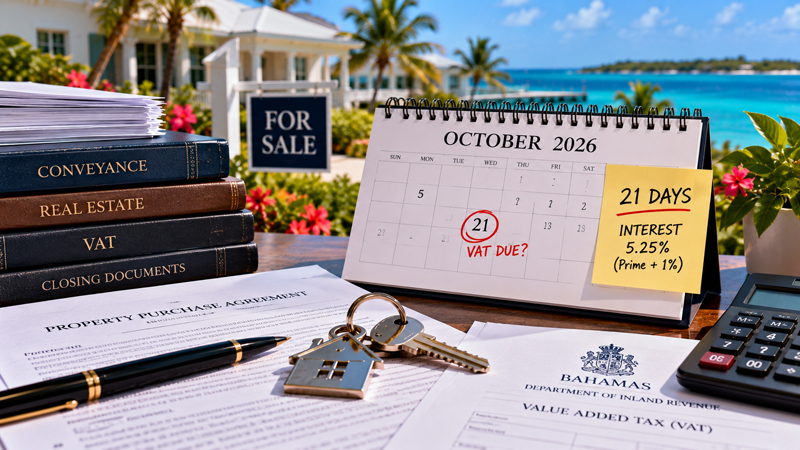
NASSAU, The Bahamas – Twenty-one days sounds like plenty of time to pay a tax.
Unless you’re trying to close a property sale in The Bahamas.
Beginning October 5, the Department of Inland Revenue plans to impose interest on VAT due on real-estate transactions when payment isn’t made within 21 days of execution of the conveyance.
The interest rate is currently 5.25 percent — Prime plus one percentage point.
On paper, the objective is understandable: once a taxable transaction takes place, government shouldn’t have to wait indefinitely for its revenue.
The problem, attorneys argue, is that Bahamian property transactions frequently don’t operate on a 21-day clock.
Consider an ordinary buyer financing a home with a mortgage.
After the conveyance is executed, documents must go to the lender. Title searches and opinions may require review. The bank may take two or three weeks—or longer—to complete its work and release funds. Only then can proceeds move and the transaction finally close.
The tax clock, however, has already been ticking.
International transactions can be even more complicated. Documents may have to travel overseas for signatures and be notarized or apostilled before returning to The Bahamas.
Andrew O’Brien, chairman of the Bahamas Bar Association’s real-estate committee, argues that mortgage-financed and international buyers could therefore incur interest through no fault of their own. Attorneys have asked the DIR to postpone implementation while the timetable is reconsidered.
The Department has offered an important qualification: delays caused by the DIR itself will be deducted from the 21-day calculation. Officials also say the interest shouldn’t be confused with the separate penalty imposed on substantially overdue payments.
Still, the larger issue is worth considering.
The Bahamas has spent decades positioning itself as an attractive jurisdiction for second homes, investment property and international buyers.
Those buyers don’t judge the country solely by its tax rate.
They also judge it by how predictable and efficient it is to complete a transaction.
A rule intended simply to encourage prompt tax payment could therefore have an unintended consequence if the deadline is shorter than the transaction process it governs.
Twenty-one days isn’t a very long time.
But in Bahamian real estate, it could become a surprisingly expensive three weeks.
BahamasB2B Business | September 2026


