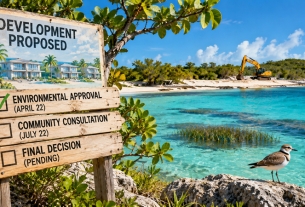
The Bahamas has committed $100 million to transforming its vast seagrass meadows into a source of climate finance. The Government envisions a new economic opportunity built around one of the country’s greatest natural assets. But with no carbon credits yet sold, important questions remain about the financing, the scientific verification, the potential returns and how much of the money will actually reach Bahamian communities.
By BahamasB2B | November 19, 2026
There may be a fortune lying beneath the shallow turquoise waters of The Bahamas.
Not in oil.
Not in precious metals.
And not in some undiscovered shipwreck.
The potential treasure is something that has been there for thousands of years: seagrass.
Stretching across the Great Bahama Bank, Little Bahama Bank and other shallow marine environments, these underwater meadows are among the most extensive on Earth.
They provide habitat for marine life, support commercial fisheries, stabilise sediments and help protect coastal ecosystems.
They also capture carbon dioxide and store carbon in their vegetation and underlying sediments.
That last characteristic has attracted the attention of scientists, governments and international investors.
As countries and corporations search for ways to reduce their contribution to climate change, ecosystems capable of removing and storing atmospheric carbon have acquired potential commercial value.
The Bahamas wants to turn that environmental service into a new source of national income.
At the COP31 climate summit in Türkiye on November 11, Prime Minister Philip Davis announced an additional $75 million commitment to the Bahamas Blue Carbon Programme.
Combined with the $25 million already committed to the programme’s first phase, the announcement brings the Government’s stated investment to $100 million.
It is an ambitious undertaking.
It could help finance marine conservation, scientific research, environmental restoration and economic development throughout the Family Islands.
But it is also a financial proposition whose ultimate returns remain uncertain.
Before Bahamians celebrate a new national revenue stream, they deserve to understand exactly how the programme is financed, what it will cost and how its benefits will be distributed.
The Largest Seagrass Meadows on Earth
The Bahamas possesses an extraordinary natural advantage.
According to the Government, its seagrass meadows cover approximately 53,000 square kilometres.
That is an enormous area of shallow marine habitat, extending across waters that have supported Bahamian fishing, transportation and coastal communities for generations.
Seagrass performs several important environmental functions.
It absorbs carbon dioxide through photosynthesis.
Some of the carbon is incorporated into plant material, while some can accumulate in sediments beneath the meadows.
Under suitable conditions, sediment carbon can remain stored for long periods.
Seagrass also provides nursery habitat for fish and other marine species, helps stabilise the seabed and contributes to water quality.
These benefits have existed for centuries.
What has changed is the possibility of assigning an economic value to some of them through international carbon markets.
The Government believes that properly measuring and protecting these ecosystems could allow The Bahamas to receive compensation for verified climate benefits.
That possibility has generated considerable excitement.
But there is an important distinction between the amount of carbon stored in an ecosystem and the number of carbon credits that can legitimately be issued.
The two are not interchangeable.
A Resource Is Not Yet a Revenue Stream
A carbon credit generally represents one metric tonne of carbon dioxide equivalent that has been reduced or removed under an approved accounting methodology.
But a country cannot simply measure the carbon already stored beneath its waters and sell the entire quantity as credits.
A credible carbon programme must establish a baseline.
It must determine what would happen without the proposed conservation or restoration activity.
It must demonstrate that the claimed climate benefit is additional to that baseline.
And it must account for uncertainty, potential reversals and the possibility that emissions or environmental damage are displaced elsewhere.
These requirements are particularly challenging for large natural ecosystems.
Protecting an existing seagrass meadow is environmentally valuable.
But the amount of carbon that protection can generate as a marketable credit depends on the applicable methodology and the demonstrated effect of the intervention.
A meadow that has stored carbon for centuries does not automatically create a new credit simply because its carbon stock has been measured.
That distinction is fundamental to the financial viability of the Bahamian programme.
The Government must demonstrate not only that its seagrass is valuable, but that specific conservation or restoration activities produce climate benefits that qualify under internationally accepted accounting rules.
Until that process is completed, estimates of potential carbon-credit revenues remain speculative.
The First $25 Million
The Government says it has invested $25 million in the first phase of the Blue Carbon Programme.
That phase has focused on establishing the scientific foundation necessary for future carbon-market participation.
The work includes satellite mapping, LiDAR surveys, field sampling, seagrass assessment and the development of a national carbon inventory.
These activities are essential.
Without credible measurements, The Bahamas cannot establish the quantity of carbon stored in its marine ecosystems or reliably measure changes over time.
But the financing of that initial phase deserves closer examination.
In November 2025, Tribune Business reported that a $25 million credit facility had been arranged by ArtCap Strategies, an investment firm involved in the programme.
Anthony Ferguson, president of CFAL and a director of Carbon Management Ltd, described the financing as a major step toward completing the mapping and scientific validation.
Carbon Management Ltd is the special-purpose company involved in developing the country’s blue-carbon assets.
According to that reporting, the Government holds a 49 percent interest in the company.
That raises an obvious question.
When the Government describes the initial $25 million as its investment, is it referring to money directly appropriated from public funds, borrowing undertaken by a project company, a government-supported financing arrangement or some combination of those mechanisms?
The distinction matters.
A direct government expenditure affects public finances differently from a commercial loan to a separate company.
And a loan supported by government guarantees may create contingent liabilities even if the funds are not immediately recorded as ordinary government expenditure.
The public should be told precisely which arrangement applies.
Who Owns the Company?
The reported ownership structure of Carbon Management Ltd deserves particular scrutiny.
If the Government owns 49 percent, who owns the remaining 51 percent?
What capital have the respective shareholders contributed?
Who appoints the directors?
Who controls major financial decisions?
And how will profits, fees and other economic benefits be distributed?
These questions should not be interpreted as allegations of wrongdoing.
Public-private partnerships can provide access to expertise and capital that governments may not possess internally.
A properly structured partnership could be a sensible way to develop a technically complex national programme.
But the value of a partnership depends heavily on its contractual terms.
If the principal underlying resource is a national environmental asset, the public should understand how much of the resulting economic value will remain under Bahamian public control.
The Government has repeatedly emphasised that the country’s carbon assets remain sovereign national resources.
That is an important assurance.
But sovereign ownership of a resource and the contractual distribution of revenue generated from that resource are two different matters.
Both deserve examination.
The Additional $75 Million
At COP31, Prime Minister Davis announced that the Government had committed another $75 million to Phase Two.
He said the money would support measurement, reporting, verification and implementation of conservation activities.
The announcement was presented as a transition from scientific preparation to practical implementation.
But the public statements reviewed for this article do not provide a detailed financing schedule for the additional commitment.
They do not establish whether the entire $75 million has already been raised or disbursed.
Nor do they identify all lenders, investors, repayment obligations, interest costs or potential government guarantees associated with Phase Two.
That is a significant gap in the information available to taxpayers.
A commitment is not the same as an expenditure.
A financing facility is not the same as cash received.
And an announced programme budget is not proof that the money has been transferred to the organisations responsible for carrying out the work.
These distinctions are particularly important when a project is described as a $100 million national investment.
The Government should publish a financial schedule identifying the amounts committed, legally contracted, drawn down and actually spent.
It should also explain how much of the total represents public money and how much comes from private investors or other financing sources.
Without that information, the $100 million figure describes the scale of the Government’s ambition more clearly than it describes the programme’s present financial position.
The Billion-Dollar Possibility
The financial ambitions do not end at $100 million.
In November 2025, officials associated with the programme discussed the possibility of raising between $500 million and $1 billion through a future blue-carbon bond.
The proposed financing would reportedly be drawn down over several years and used to support environmental and sustainable-development objectives.
Such a transaction, if successfully structured, could represent a major source of capital for The Bahamas.
But it is essential to distinguish an anticipated bond issue from money already secured.
A proposed $1 billion financing is not $1 billion in revenue.
Nor is borrowing equivalent to earning money from carbon-credit sales.
A bond generally creates repayment obligations.
Those obligations may be supported by future project revenues, contractual arrangements or other financial resources, depending on the structure.
If future carbon-credit income falls below expectations, the consequences depend on who bears the repayment risk.
That is why the proposed bond deserves careful scrutiny before it is marketed as an economic windfall.
Who would issue the bonds?
What would secure them?
What interest would investors receive?
Would the Government provide guarantees?
And what happens if carbon-credit prices decline or verification produces fewer eligible credits than anticipated?
The answers will determine whether the financing strengthens the country’s long-term financial position or creates new obligations dependent upon uncertain future income.
How Carbon Credits Would Be Verified
The Government has adopted a more cautious approach to carbon-credit issuance than some earlier public statements suggested.
At COP31, Davis confirmed that no credits had yet been authorised, issued or sold.
He emphasised that the country would proceed only when the scientific and regulatory requirements had been satisfied.
The Government is developing a national inventory intended to meet Tier 2 standards under the Intergovernmental Panel on Climate Change framework.
Tier 2 accounting uses more country-specific data and emission factors than basic default methods.
That can improve the accuracy of national greenhouse-gas estimates.
But an improved national inventory is not, by itself, sufficient to establish that particular carbon credits are eligible for international sale.
The programme must also demonstrate the climate benefit of the relevant activities under an accepted methodology.
Independent verification will be essential.
The verification process should examine the scientific baseline, the measurement techniques, the permanence of carbon storage and the risk that credited benefits could be reversed.
It should also establish whether the claimed reductions or removals would have occurred without the project.
These requirements are not merely technical formalities.
They determine whether the credits have genuine environmental value.
And genuine environmental value is essential to attracting credible buyers.
Article 6: A Different Kind of Market
The Bahamas is pursuing participation under Article 6 of the Paris Agreement.
Article 6 allows countries to cooperate in meeting their climate commitments, including through the international transfer of certain verified mitigation outcomes.
These are known as Internationally Transferred Mitigation Outcomes, or ITMOs.
The Government has indicated that it favours this sovereign framework over relying exclusively on voluntary carbon markets.
That distinction is important.
In a voluntary carbon market, companies or other organisations may purchase credits to support environmental claims or voluntary climate commitments.
Under Article 6.2, countries can establish cooperative arrangements involving authorised mitigation outcomes that may be counted toward national climate commitments, subject to applicable accounting rules.
The Bahamas enacted the Climate Change and Carbon Market Initiatives Act and the Carbon Credit Trading Act in 2022 to establish a domestic framework for carbon-market activity.
The Government says these laws support a national registry and the regulation of carbon assets.
But the existence of legislation does not eliminate the need for project-level verification, authorisation and transparent accounting.
One particularly important safeguard concerns double counting.
If The Bahamas transfers an authorised mitigation outcome to another country for use toward that country’s climate target, the corresponding accounting adjustment must prevent both countries from claiming the same benefit.
Davis has committed to that principle.
The challenge will be implementing it through reliable registries, transparent reporting and independently verifiable transactions.
Who Will Buy the Credits?
The Government has invited foreign governments, investors and potential purchasers to begin discussions about future carbon transactions.
That is an encouraging sign of commercial interest.
But expressions of interest are not binding purchase agreements.
No confirmed sales have been announced.
Nor has the Government published a schedule of expected prices or volumes for future Bahamian ITMOs.
The value of carbon credits can vary considerably depending on the methodology, project type, quality, buyer requirements and market conditions.
High-integrity credits may attract stronger demand.
But there is no guaranteed market price for a future Bahamian credit.
A credible financial projection should therefore use several scenarios.
What happens if credits sell at a relatively low price?
What happens if the verification process produces fewer credits than expected?
How much revenue must be generated simply to cover the programme’s operating and financing costs?
And what portion of the proceeds would remain available for conservation and community development after those costs are paid?
Without answers, even an impressive estimate of the carbon stored beneath Bahamian waters cannot be translated into a reliable forecast of national income.
The Communities Above the Carbon
The Government has repeatedly promised that Bahamian communities will share in the benefits.
That commitment is essential to the programme’s legitimacy.
The seagrass meadows are not isolated financial assets.
They are part of living ecosystems that support fishermen, boat operators, tourism businesses and coastal communities throughout the archipelago.
The people whose livelihoods depend upon those environments have a direct interest in how they are managed.
A successful blue-carbon programme could support sustainable fisheries, habitat restoration, coastal protection and improved water quality.
It could also create employment for Bahamian marine scientists, technicians, divers, data analysts and environmental specialists.
The Government has discussed opportunities involving education, healthcare, transportation and climate-resilient infrastructure.
Catholic Relief Services has also been identified as a partner in the programme’s sustainable-development component.
These are worthwhile objectives.
But the mechanism for distributing the benefits remains insufficiently defined in the public information available.
Will Family Island communities receive direct allocations from carbon revenues?
Will funds be distributed through local government?
Will grants be available to fishing associations, conservation organisations and community groups?
Will residents participate in deciding which projects receive support?
And how will the Government ensure that the islands hosting the ecosystems receive a fair share of the economic value?
Those questions deserve answers before the first credits are sold.
The Bahamas Blue Economy Institute
At COP31, Davis announced plans to establish the Bahamas Blue Economy Institute.
The proposed institution would support scientific research, environmental programmes and the management of proceeds from future carbon transactions.
The Prime Minister described it as a vehicle for ensuring that the benefits of the programme continue beyond individual project cycles.
That could be a valuable development.
A professionally managed institution with strong governance could help separate long-term conservation priorities from short-term political pressures.
But its credibility will depend on its structure.
Who will appoint its board?
Will it publish independently audited financial statements?
Will its investment and grant-making decisions be transparent?
Will scientists and Family Island representatives have meaningful roles in its governance?
And will its spending be subject to parliamentary oversight?
The Government should establish these arrangements before substantial carbon revenues begin flowing through the institution.
The history of public investment vehicles in The Bahamas demonstrates the importance of clear governance from the outset.
An institution created to protect the country’s natural inheritance should be designed to earn public confidence.
The Risk of Selling Yesterday’s Conservation
The Bahamas has a long history of environmental protection.
Successive governments have adopted measures intended to protect marine resources, including restrictions on longline fishing, sea-turtle harvesting and shark fishing.
These decisions have helped preserve ecosystems that now attract international attention.
But the existence of earlier conservation measures raises a difficult question for carbon-credit accounting.
If an ecosystem was already protected, what new environmental benefit is being financed by a carbon transaction?
This is the problem of additionality.
A credit should represent a qualifying climate benefit beyond what would otherwise have occurred.
Protecting a valuable existing ecosystem can be a legitimate conservation objective.
But crediting that protection requires a defensible demonstration of avoided emissions or additional removals under an accepted methodology.
That may involve identifying credible threats, implementing new protections, restoring damaged areas or undertaking other measurable interventions.
The Government must avoid treating the country’s entire historical carbon stock as though it automatically represents a newly created marketable commodity.
Such an approach could undermine the credibility of the programme and discourage serious international buyers.
Protecting the Asset Itself
There is another concern.
The value of the blue-carbon programme ultimately depends on the continued health of the seagrass meadows.
Yet Bahamian marine environments face pressures from coastal development, dredging, pollution, vessel activity and climate change.
A programme designed to monetise carbon storage cannot succeed indefinitely if the underlying ecosystems are being degraded.
This creates a direct connection between carbon finance and ordinary environmental regulation.
If the Government intends to generate revenue from protecting marine habitats, it must also ensure that development approvals, wastewater management, fisheries policies and coastal planning support that objective.
The carbon programme should not operate in isolation from the country’s broader environmental responsibilities.
A national seagrass inventory could provide valuable information about habitat degradation.
It could help identify areas requiring restoration or stronger protection.
But that information must be used in actual policy decisions.
The success of the programme should ultimately be measured not only by the number of credits sold, but by the condition of the marine ecosystems it is intended to protect.
The Lessons of Earlier Resource Promises
The Bahamas has heard ambitious promises about natural-resource wealth before.
Over the decades, governments have explored opportunities involving oil, seabed minerals, fisheries, tourism development and other national assets.
Some initiatives have generated lasting economic benefits.
Others have produced little more than projections, political controversy and unrealised expectations.
The recurring lesson is that the existence of a valuable resource does not guarantee a profitable industry.
Successful resource development requires sound science, credible markets, transparent contracts, effective regulation and careful financial management.
Blue carbon is no exception.
Indeed, the technical complexity of international carbon accounting makes transparency particularly important.
Most Bahamians will not have the expertise to evaluate satellite measurements, sediment-carbon calculations or international carbon registries.
They should nevertheless be able to understand the financial arrangements and determine whether the programme is producing measurable benefits.
That is the responsibility of the institutions administering it.
What the Government Should Publish
The Government has an opportunity to establish a higher standard of transparency for this programme.
It should begin by publishing a complete financial account of the first $25 million.
That account should identify the source of the financing, the borrowing entity, repayment terms, any public guarantees and the amounts actually disbursed.
The same information should be provided for the additional $75 million commitment.
The Government should also publish the ownership and governance arrangements of Carbon Management Ltd, including the rights and responsibilities of its shareholders.
The scientific methodology should be made available for independent review.
That includes the seagrass mapping results, sampling protocols, carbon estimates, verification standards and the assumptions used to calculate eligible mitigation outcomes.
Future carbon transactions should be recorded in a publicly accessible registry.
The public should be able to identify the quantity of credits authorised, the purchaser, the applicable price where disclosure is legally permissible, and the accounting treatment.
Finally, the Government should establish a transparent mechanism for distributing the proceeds.
The amount allocated to conservation, administration, debt service, private partners and community development should be clearly reported.
Without that information, the public will have little basis for evaluating the programme’s financial success.
A Different Kind of National Wealth
The Bahamas has traditionally earned much of its foreign exchange by inviting people to enjoy its natural beauty.
Tourism has transformed the economy.
But it has also exposed the country to the vulnerabilities of an industry dependent upon international travel, external economic conditions and the health of the environment.
Blue carbon offers the possibility of a different relationship with nature.
Instead of earning income primarily by developing or consuming environmental assets, the country could potentially earn income by protecting and restoring them.
That is an attractive proposition.
It could create an economic incentive for conservation.
It could support scientific research and provide new opportunities for young Bahamians.
And it could help finance environmental protection that might otherwise be difficult to sustain.
But the proposition will succeed only if the financial arrangements are sound and the environmental claims are credible.
The country cannot afford to confuse the potential value of its marine resources with money already earned.
Nor should the promise of future carbon revenue obscure the costs and obligations being undertaken today.
The $100 Million Question
The Prime Minister has described the blue-carbon programme as an investment in national self-reliance.
That is an appealing objective.
The Bahamas possesses an extraordinary natural inheritance, and it is reasonable to explore ways of ensuring that the world recognises the value of protecting it.
The Government deserves credit for recognising the potential importance of the country’s seagrass ecosystems and investing in the scientific work required to understand them.
But recognition is not the same as commercial success.
The programme has now reached a stage where financial transparency is as important as environmental ambition.
The public needs to know how the $100 million commitment is being financed.
It needs to know who controls the programme, who will be repaid and who will receive the proceeds.
It needs independent confirmation that any carbon credits sold represent genuine climate benefits.
And it needs a clear commitment that the communities whose lives depend upon the sea will share meaningfully in the rewards.
The Bahamas may indeed possess one of the world’s most valuable blue-carbon resources.
But the value of that resource will ultimately be determined by more than the amount of carbon stored beneath the seabed.
It will depend on the integrity of the science, the quality of the contracts and the fairness of the benefits.
The seagrass belongs to The Bahamas.
The financial obligations must be understood by Bahamians.
And if the programme succeeds, the prosperity it creates must reach the people whose natural inheritance makes it possible.
That is the real test of the $100 million bet beneath our seas.