FREEPORT, Grand Bahama – Most Bahamians rarely think about aggregate.
They think about houses, hotels, roads, docks, schools and hospitals.
But underneath much of what The Bahamas has built is something considerably less glamorous: crushed Bahamian limestone.
And this week, the future supply of some of that rock is uncertain.
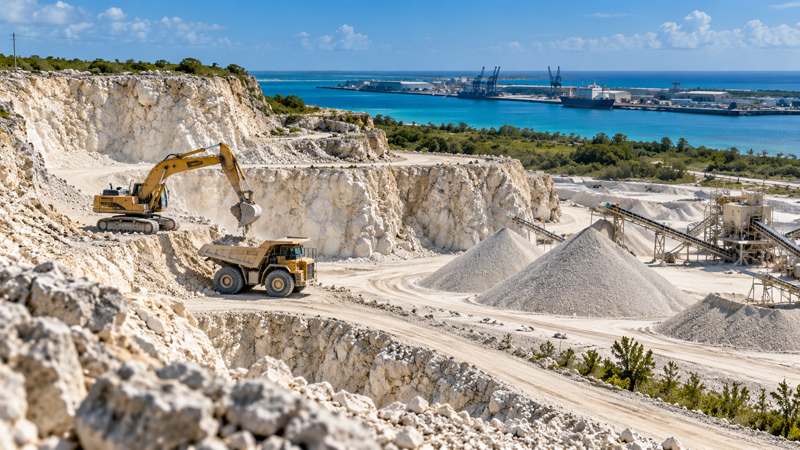
Bahama Rock plans to halt aggregate production on Sept. 18 as its currently permitted limestone reserves approach exhaustion. Sixty-nine hourly employees are expected to be temporarily laid off beginning Sept. 21, while the company waits for government approval to access new limestone reserves at the former Bahamas Cement Company property.
The dispute is about jobs. But it is also about construction costs, the environment and a piece of Grand Bahama’s industrial history stretching back more than 60 years.
The rock beneath Freeport
To understand today’s dispute, it helps to go back to the creation of modern Freeport.
In the 1950s and 1960s, Grand Bahama was being transformed under the Hawksbill Creek Agreement from a sparsely populated island into an ambitious industrial and commercial centre built around a deep-water harbour.
American industrialist Daniel Ludwig dredged the harbour and later sold land to the Bahamas Cement Company. The company, a subsidiary of U.S. Steel, opened its Freeport operation in 1965. Limestone and material obtained through dredging helped feed cement production while industrial activity surrounding the harbour became part of Freeport’s economic foundation.
Bahamas Cement eventually disappeared.
The limestone did not.
Today, Bahama Rock—owned by U.S.-based Martin Marietta—supplies aggregate used in construction throughout The Bahamas. Grand Bahama Chamber of Commerce president Ralph Hepburn says its material has gone into projects ranging from Baha Mar to marinas and major developments around the country.
One Bahama Rock employee put it more simply during last week’s worker demonstration:
“Y’all foundation starts here with us.”
She was speaking literally as much as figuratively.
But there is another side
Bahama Rock wants to excavate roughly 270 acres of the former Bahamas Cement property, eventually creating new turning areas and deep-water berths as part of an expansion of Freeport Harbour. The company says access to the limestone would allow production to continue and preserve jobs.
Nearby residents are not convinced.
People in Eight Mile Rock and surrounding communities have raised concerns about blasting, dust, groundwater, flooding and possible property damage. Similar complaints are not new: The Tribune was reporting residents’ allegations of cracked walls and damaged foundations associated with blasting a decade ago.
Environmental group Preserving Paradise has also challenged the suggestion that a Bahama Rock shutdown automatically means a national aggregate shortage, calling instead for an independent assessment of alternative Bahamian suppliers.
That makes this more complicated than a simple choice between jobs and environmentalists.
The Government’s Department of Environmental Planning and Protection has now requested revisions to Bahama Rock’s environmental documents as the statutory review continues.
History comes around again
There is an intriguing footnote.
In 2004, BahamasB2B reported on another controversial proposal for this very same former Bahamas Cement property: a planned $700 million liquefied natural gas facility overlooking the entrance to Freeport Harbour.
Then, as now, the argument involved industrial development, the harbour, competing economic interests and questions about what should occupy one of Grand Bahama’s most strategically important pieces of land.
More than two decades later, the project has changed.
The fundamental argument has not.
Grand Bahama needs investment and jobs. The country needs affordable construction materials. Nearby communities also have a legitimate interest in what happens to their homes and environment.
Somewhere among those competing interests lies the future of Bahama Rock.
And perhaps that is why this story matters beyond 69 temporary layoffs.
For more than half a century, limestone from Grand Bahama has helped build the modern Bahamas.
Now the country must decide how much more rock it is prepared to move—and at what cost.
BahamasB2B Analysis | Sept. 16, 2026