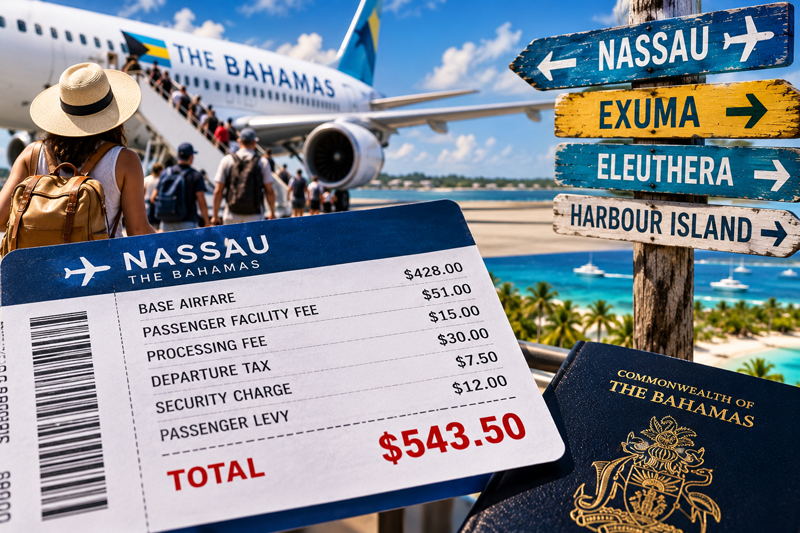
The Bahamas wants more stopover tourists, more Family Island visitors and more airline service. But every new fee raises a simple question: At what point do we begin taxing the very growth we’re trying to create?
NASSAU, The Bahamas — The Bahamas has a tourism problem most countries would envy.
We welcomed a record 12.5 million visitors in 2025.
But as BahamasB2B recently examined, there is an important number underneath that extraordinary number: the overwhelming majority arrived by sea.
Cruise passengers now account for roughly 86 percent of Bahamian visitor arrivals.
Stopover tourists—the people who fly here, sleep in our hotels, eat repeatedly in our restaurants, ride in our taxis, rent cars, buy groceries, visit attractions and spend several days in the country—represent a much smaller share.
The Ministry of Tourism itself calls stopovers the country’s highest-value visitor segment.
And there is encouraging news.
Through July 2026, The Bahamas welcomed a record 1,314,639 stopover visitors, up 4.3 percent from the same period last year. March, April, June and July all established monthly records. Tourism Today
We want more of them.
Which makes something else increasingly difficult to understand.
Why do we keep making it more expensive to fly here?
Another fee
Beginning January 1, 2027, travelers using three important Family Island airports—North Eleuthera, Governor’s Harbour and Exuma—are scheduled to face significant new passenger charges associated with privately financed airport improvements.
For an international passenger, the new passenger facility fee is $51 and the processing fee $15.
That’s $66.
Add the existing government departure tax, security charge and passenger levy and the direct passenger charges associated with leaving these airports rise to roughly $105 per international traveler, before considering other applicable costs. The Tribune
Domestic travelers will feel it too.
The new facility and processing charges total $33 for domestic passengers. Together with existing government charges, the direct total approaches $70. Tribune 242
For a family of four flying internationally from Exuma or Eleuthera, we’re no longer talking about pocket change.
And that’s before buying the airline tickets.
There is a perfectly reasonable explanation
Airports cost money.
And anyone who has traveled through some of our Family Island airports knows that substantial investment has been overdue.
Modern terminals aren’t luxuries.
Runways must be maintained. Fire and rescue capabilities must meet international standards.
Security costs money. Baggage facilities, lighting, navigation, parking aprons and terminals require investment.
The airport redevelopment programme is intended to provide exactly that.
So this isn’t an argument that passengers should never pay for infrastructure they use.
The question is whether anyone is looking at the cumulative cost.
Because the tourist doesn’t distinguish between a passenger facility fee, processing fee, security fee, departure tax or passenger levy.
The visitor sees one thing: the price of the ticket.
And now there may be another aviation charge
At the same time, another controversy is developing over proposed charges associated with the Bahamas Aviation, Climate and Severe Weather Network—BACSWN.
The final fee has not yet been established, an important distinction amid widespread discussion of an earlier $775 figure.
BACSWN says that figure is outdated and that any eventual charge will be considerably lower. It says its proposed methodology will follow international aviation principles and that airlines will be consulted before charges are introduced. The Tribune
But major airlines are already concerned.
Airlines for America, representing carriers including American, Delta, United and JetBlue, has questioned proposed Bahamian aviation charges and raised concerns about paying for services it says may duplicate services already provided through existing arrangements. The Tribune
That dispute involves complicated questions of air-navigation services, meteorology, international aviation agreements and who provides what service in Bahamian airspace.
Those questions deserve careful examination.
But for the tourism industry, there is a simpler one:
Who eventually pays?
Airlines do not operate charities.
Higher operating costs eventually have consequences—through ticket prices, capacity decisions, route economics or some combination of the three.
An airline route is a business too
This is particularly important because people sometimes imagine airlines deciding where to fly primarily according to demand.
Demand matters enormously.
But so does economics.
An airline deciding whether to add another Nassau frequency—or whether Freeport, Exuma or Eleuthera can support a new route—calculates what it costs to put an aircraft there and what it expects to earn.
Fuel.
Crew.
Aircraft utilization.
Landing charges.
Navigation fees.
Airport charges.
Taxes.
Passenger fees.
And dozens of other costs.
A route doesn’t have to become wildly unprofitable before an airline changes its mind.
It merely has to become less attractive than somewhere else the aircraft could fly.
And there is the part we sometimes forget.
The Bahamas isn’t competing against itself.
Paradise has competitors
The American traveler contemplating a winter vacation isn’t necessarily deciding between Nassau and Exuma.
He may be deciding between The Bahamas and Aruba.
The Dominican Republic.
Cancún.
Jamaica.
Puerto Rico.
Turks and Caicos.
The Cayman Islands.
Or somewhere else entirely.
The same applies to airlines.
Aircraft are movable assets.
If an airline believes an additional aircraft can produce a better return flying somewhere else in the Caribbean, Latin America or the United States, it can send it there.
The Bahamas possesses extraordinary natural advantages.
But beautiful water does not repeal economics.
Consider Mexico
That is why BahamasB2B recently welcomed the announcement of the first scheduled nonstop service between Mexico City and Nassau.
Aeroméxico plans to begin the route in March 2027, subject to regulatory approval.
We argued that the importance of the service isn’t simply the passengers aboard one aircraft.
Mexico City is an enormous market and aviation hub. The route gives The Bahamas access to travelers beyond our traditional dependence on the United States and creates connections into a much larger Latin American network.
That is exactly the sort of airlift diversification The Bahamas should want.
So imagine spending years persuading an airline to establish a new route—and then steadily increasing the cost of operating it.
At some point we have to ask whether one arm of national policy understands what another arm is trying to accomplish.
The Family Islands face an even greater problem
Nassau has volume.
Family Island destinations frequently don’t.
That makes the economics much more fragile.
A visitor choosing Harbour Island, Eleuthera or Exuma already accepts that getting there may cost considerably more than flying to Nassau or many mass-market Caribbean destinations.
For high-end travelers, that premium may not matter much.
But not every Family Island visitor is wealthy.
Neither is every Bahamian who needs to travel between islands.
And Family Island tourism cannot grow indefinitely by assuming that anyone concerned about price is simply the wrong customer.
Even luxury travelers notice when something becomes unnecessarily expensive.
More importantly, airlines notice.
Eleuthera tourism operators have already warned that the airport improvements present a “double-edged sword”: better facilities can support additional airlift, but higher charges can simultaneously make the destination less competitive. The Tribune
That’s exactly the dilemma.
We need the airports.
We also need people to use them.
The infrastructure paradox
Suppose we spend millions building a beautiful new airport.
The terminal is modern.
The runway is improved.
The passenger experience is dramatically better.
To finance it, we increase passenger and aircraft charges.
The higher costs contribute to higher fares.
Higher fares suppress some demand.
Reduced demand makes marginal airline routes less attractive.
Less airlift makes the destination harder and more expensive to reach.
And the magnificent new airport handles fewer passengers than projected.
That’s the infrastructure paradox The Bahamas must avoid.
An airport isn’t economically successful because it is beautiful.
It is successful because people fly through it.
We’ve seen the other side of this equation
Our recent examination of Grand Bahama illustrates why this matters.
Grand Bahama’s July visitor arrivals more than doubled, largely because sea arrivals exploded.
Yet air arrivals actually fell 10 percent.
The island gained enormous visitor volume while the part of tourism most closely associated with hotels and overnight stays moved in the opposite direction.
That doesn’t diminish the value of cruise tourism.
It demonstrates why rebuilding stopover tourism is so important.
And you cannot rebuild stopover tourism without airplanes.
Stop counting fees individually
Perhaps the problem is that government and infrastructure providers naturally examine each charge individually.
Twenty-nine dollars here.
Nine dollars there.
Another dollar somewhere else.
A facility fee.
A processing fee.
An aviation charge.
Each one can have a perfectly defensible purpose.
Each one may finance something worthwhile.
And each one, considered alone, may appear small relative to the cost of a vacation.
But travelers don’t purchase fees individually.
They purchase a trip.
The Bahamas therefore needs to start examining aviation costs the way the customer does:
all at once.
Before approving another charge, policymakers should be able to answer some basic questions.
What is the total tax-and-fee burden on a typical round-trip airline passenger?
How does it compare with competing Caribbean destinations?
How much has that burden increased over five and ten years?
What percentage of a short-haul Miami–Bahamas fare consists of taxes and fees?
What happens to demand when another $20, $40 or $60 is added?
And what does it do to a Bahamian family traveling domestically?
Those answers should come before another fee is imposed, not after airlines and hotels complain.
The visitors we need
There is a larger tourism strategy hiding inside this debate.
The Bahamas has become extraordinarily successful at attracting enormous numbers of cruise passengers.
We should continue benefiting from that business.
But if we want more tourism dollars circulating through hotels, restaurants, taxis, rental cars, attractions and Bahamian-owned businesses, we also need to grow the number of visitors who arrive with something cruise passengers generally don’t bring: luggage for several nights.
That means airlift.
And airlift depends partly upon affordability.
The Bahamas cannot control the price of jet fuel.
We cannot control international economic conditions.
We cannot dictate airline pricing.
But we can control how much cost we ourselves add to the journey.
Build better airports. But fill them.
The Bahamas absolutely should modernize its airports.
We should have first-class weather services.
We should have safe airspace, modern navigation, excellent security and terminals worthy of one of the world’s great tourism destinations.
Those things cost money.
But every dollar extracted from aviation should ultimately be measured against the economic activity aviation makes possible.
A visitor paying a little more at the airport may generate hundreds—or thousands—of dollars in Bahamian economic activity during a week-long stay.
Lose that visitor over the cumulative price of the trip and we haven’t merely lost an airport fee.
We’ve lost the hotel room.
The restaurant meals.
The taxi rides.
The excursions.
The shopping.
And perhaps the repeat visit next year.
The Bahamas has spent decades trying to persuade more people to fly to our islands.
In 2026, stopover tourism is finally setting records again.
We should be very careful not to celebrate that success with another invoice.
Because the objective isn’t to collect the most money possible from every airplane that arrives.
The objective is to give more airplanes a reason to arrive.
BahamasB2B Analysis | September 2026