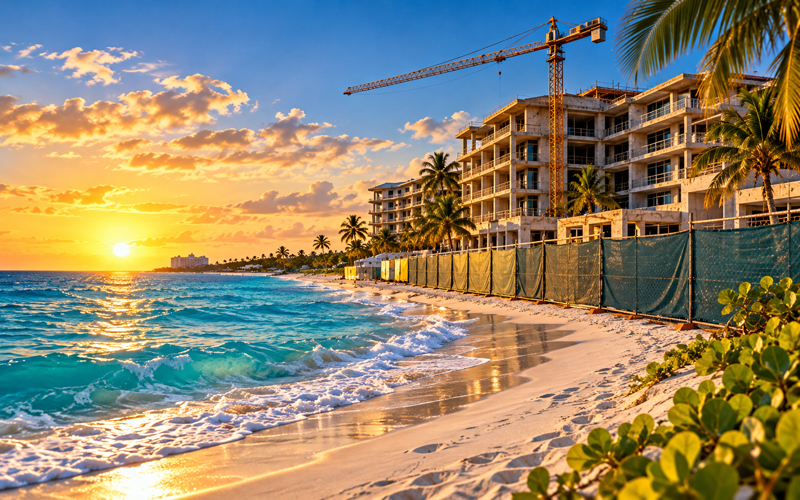
A $550 million luxury development on Paradise Island has reignited an old Bahamian argument: how much of our coastline can be developed before public access becomes a privilege rather than a right? The controversy surrounding Cabbage Beach is about considerably more than a construction fence.
By BahamasB2B
There are few things more distinctly Bahamian than the beach.
Our beaches are the foundation of our tourism industry, the backdrop to our international advertising, and an important part of the everyday lives of Bahamians.
They are also among the most valuable pieces of real estate in the Caribbean.
And increasingly, those two realities are colliding.
The latest confrontation is taking place at Cabbage Beach on Paradise Island, where construction associated with the $550 million Four Seasons Ocean Club Residences has triggered protests, demands for government transparency, and renewed concerns about public access to the shoreline.
The immediate dispute concerns a construction fence.
But the underlying question is much larger.
Whose beach is it anyway?
A $550 Million Development and a 15-Foot Promise
The Four Seasons Ocean Club Residences project is an ambitious luxury residential development planned for a 6.156-acre site overlooking Cabbage Beach.
The development involves 67 private residences, with reported asking prices ranging from $6.5 million to $23 million.
It is backed by Access Industries, which owns the existing Ocean Club, working with Two Roads Development and the Four Seasons brand.
For The Bahamas, it represents another substantial commitment of foreign capital to the country’s high-end tourism and residential market.
The project promises construction employment, opportunities for Bahamian contractors, and additional economic activity.
But it also occupies an especially sensitive location.
Cabbage Beach is one of New Providence’s most recognisable stretches of shoreline, visited by tourists and Bahamians alike and supporting a network of vendors, water-sports operators and other small businesses.
According to an October 6 investigation by Tribune Business, the project’s October 21, 2024 Heads of Agreement includes a specific commitment to provide a permanent 15-foot-wide pedestrian easement along the development’s western boundary.
That route is intended to connect the nearest public road with Cabbage Beach.
The agreement also provides for landscaping and improvements intended to make the route safer.
On paper, therefore, public access is not being eliminated.
It is being formally provided for.
But there is a complication.
Thirty Months Is a Long Time
The Heads of Agreement acknowledges that the proposed access route will be temporarily closed during construction, a period expected to last approximately 30 months.
During that time, members of the public are expected to use alternative routes, including access near Atlantis and a passage between Ocean Club Beach Estates and Paradise Harbour Club.
The developer is also required to work with the Government on a best-efforts basis to accommodate beach vendors through the construction site.
That distinction is important.
The agreement does not provide an unconditional guarantee that vendors will retain access through the development throughout construction.
And the public’s proposed alternative routes have themselves become controversial.
The advocacy group Dis We Beach has questioned whether the identified routes are genuinely available and legally secured.
The group has asked the Government to publish maps, easements, environmental approvals and other documents establishing exactly where the public can go.
These are reasonable questions to examine.
A promise of beach access is only meaningful if people can actually use it.
A pathway that exists on a drawing but is difficult to locate, closed by a gate, restricted by security personnel or inconveniently distant from established access points may provide substantially less practical access than the public previously enjoyed.
And thirty months is a considerable period for someone whose livelihood depends on reaching the beach every morning.
The Vendors Are Part of the Story
For beach vendors, this is not simply a debate about public policy.
It is about earning a living.
Cabbage Beach supports Bahamians selling food, drinks, souvenirs, beach equipment and recreational services.
Some have operated in the area for decades.
Relocating them, even temporarily, can mean losing established customers, familiar operating locations and daily income.
The consequences have already extended beyond Paradise Island.
Reports indicate that the relocation of some Cabbage Beach vendors to Goodman’s Bay has generated disputes with operators already working there.
That illustrates a problem often overlooked when major development agreements are negotiated.
Moving a small business is not necessarily the same as preserving it.
A vendor’s income may depend on pedestrian traffic, relationships with nearby hotels, visibility, accessibility and the character of a particular location.
Those advantages cannot always be transferred simply by assigning another patch of sand.
The Four Seasons agreement does contemplate a future role for Bahamian vendors within the completed development.
It calls for space to accommodate vending and gives preference to existing Cabbage Beach operators, subject to licensing, training and standards consistent with the luxury development.
That could create opportunities.
But it also raises questions about how independent vendors will operate within a privately managed luxury environment.
Who decides which vendors qualify?
What fees will apply?
What restrictions will govern their operations?
And will the resulting opportunities be economically comparable to those they previously enjoyed?
Those details matter as much as the broad commitment to accommodate Bahamian entrepreneurs.
This Argument Is Older Than Paradise Island
The Bahamas has been negotiating the relationship between tourism development and public access for generations.
During the twentieth century, the country transformed itself from a relatively small colonial economy into one of the world’s most recognisable tourism destinations.
Nassau’s hotel industry expanded.
Paradise Island was developed into an international resort destination.
Cable Beach became a major tourism corridor.
And later, large-scale resort developments spread to other islands.
These investments brought employment, infrastructure, international visibility and enormous economic activity.
But beachfront development also changed the way Bahamians experienced their own coastline.
Properties that had once been relatively accessible became surrounded by hotels, gated residential communities and private developments.
The legal distinction between ownership of coastal property, rights over the foreshore and access across private land became increasingly important.
A beach may be publicly usable under applicable law, but that does not necessarily mean the public has an unrestricted right to cross every privately owned parcel of land to reach it.
Nor does a developer’s ownership of adjoining property automatically establish ownership of the public foreshore.
The precise legal position depends on property boundaries, Crown grants, recorded easements, applicable legislation and the circumstances of the site.
Those distinctions are rarely explained clearly when development controversies arise.
Instead, the argument often becomes an emotional contest between people who want investment and people who want access.
But those objectives need not be mutually exclusive.
The Problem With Negotiating Public Rights Privately
One of the most interesting aspects of the Cabbage Beach controversy is that many of the details now being debated were addressed in the project’s Heads of Agreement.
The agreement contains provisions concerning access, environmental protection, Bahamian employment and vendor participation.
Yet much of the public discussion appears to have taken place only after construction preparations became visible.
That raises an important governance question.
Should the public learn the practical consequences of a major beachfront development only when a fence goes up?
Major investment agreements frequently involve commercially sensitive negotiations.
Developers need certainty, governments want investment, and both sides may have legitimate reasons to protect certain business information.
But when an agreement affects public access, established livelihoods or environmentally sensitive coastal areas, the public has an obvious interest in understanding the terms.
At Cabbage Beach, the advocacy group Dis We Beach has demanded disclosure of environmental impact assessments, environmental management plans, permits, shoreline surveys and the approvals governing construction fencing.
The developer’s Heads of Agreement requires necessary environmental approvals before construction and contains commitments to address environmental damage caused by negligence.
The existence of those obligations is important.
But so is the public’s ability to determine how they are being implemented.
The Economics of a Beach
There is another dimension to this controversy that deserves more attention.
A beach is not merely a recreational amenity.
It is an economic asset.
For a luxury developer, beachfront property can command extraordinary prices.
For the tourism industry, an attractive and accessible coastline is a fundamental part of the destination’s appeal.
For small Bahamian entrepreneurs, the same beach may provide their primary source of income.
And for Bahamian families, it is part of the country’s shared natural heritage.
Those interests have different economic values, but they are all legitimate.
A $550 million development can be measured in construction spending, real estate sales, government revenue and employment.
The value of uninterrupted public access is harder to quantify.
So is the economic loss experienced by a vendor who must relocate for two and a half years.
That does not make those costs insignificant.
It means they require more careful consideration.
The Question Isn’t Whether We Want Investment
The Bahamas needs investment.
Luxury tourism and residential development are important parts of the national economy.
Developers have legitimate interests in protecting construction sites, managing safety risks and operating their properties.
Coastal construction may also require temporary restrictions for genuine engineering and environmental reasons.
But those interests must be balanced against established public rights and the livelihoods of people already using the area.
The Cabbage Beach controversy presents an opportunity to establish clearer expectations for future projects.
Public access arrangements could be documented and mapped before construction begins.
Temporary restrictions could be accompanied by published schedules and practical alternative routes.
Vendor relocation arrangements could be negotiated with measurable commitments and appropriate consultation.
Environmental approvals and shoreline boundaries could be made available in a form the public can understand.
And permanent access rights could be secured through legally enforceable instruments rather than relying exclusively on assurances.
These measures would not necessarily discourage investment.
Greater certainty could benefit developers as well as the public.
A Test for the Next Generation of Development
The Bahamas has built an extraordinary tourism economy around the beauty of its islands.
That success has created wealth, employment and opportunities that would otherwise not exist.
But as beachfront land becomes more valuable and development more intensive, questions about access will become increasingly difficult to avoid.
Cabbage Beach is not the first place where those questions have arisen.
It will almost certainly not be the last.
The challenge is to ensure that economic development does not gradually transform public enjoyment of the coastline into something dependent on the goodwill of adjacent property owners.
The debate should not be reduced to whether a construction fence stays up or comes down.
It should be about establishing clear, enforceable and transparent arrangements that protect legitimate public interests while allowing responsible development to proceed.
Because the beaches are not simply what The Bahamas sells to the world.
They are also part of what makes The Bahamas home.
And that is why the question of who can reach them deserves an answer before the next fence goes up.