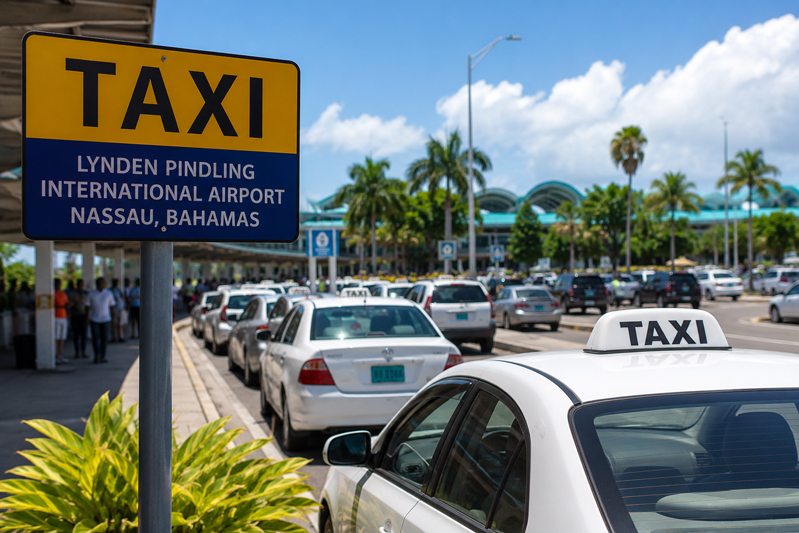
NASSAU, The Bahamas — A dispute between airport taxi operators and the government over transportation services at Lynden Pindling International Airport is drawing renewed attention—not only because of its potential impact on tourism, but because it echoes a chapter of Bahamian history that transformed the nation.
Taxi drivers have warned that industrial action remains a possibility as negotiations continue over concerns that licensed operators are facing unfair competition from livery services. Drivers contend that existing regulations are not being applied consistently, while government officials have expressed optimism that continued dialogue can resolve the matter without disrupting airport transportation.
For many Bahamians, however, the disagreement is about more than airport pickups and licensing rules.
It recalls the events that led to the 1958 General Strike, one of the defining moments in the country’s modern history. Ironically, that landmark movement also began with a dispute involving airport transportation.
When Nassau’s new international airport opened in late 1957, taxi drivers feared they would be excluded from transporting arriving visitors after exclusive arrangements were proposed for airport transfers. Taxi operators responded by blockading the airport, grounding flights and forcing negotiations. When those talks collapsed, the dispute expanded into a nationwide general strike that united workers across multiple industries and effectively brought the colony’s economy to a standstill. (Wikipedia)
The strike became far more than a transportation issue. It accelerated labor reform, strengthened workers’ rights, and helped fuel the political momentum that ultimately led to Majority Rule less than a decade later. Among its leaders was taxi union president Clifford Darling, who would later become Governor-General of The Bahamas. (Wikipedia)
Today’s dispute is fundamentally different, and there is no indication that either side expects events to escalate on anything approaching the scale of 1958. Nevertheless, the similarities are difficult to ignore. Once again, the issue centers on who has access to airport passengers, how transportation services should be regulated, and how government balances competition with the livelihoods of licensed taxi operators.
The stakes remain high because tourism remains the backbone of the Bahamian economy. For most visitors, the first face they encounter after leaving the airport is that of a taxi driver. A reliable, professional transportation system is not simply a convenience—it is part of the country’s brand.
Industry leaders are hopeful that negotiations will produce a practical solution before visitors experience any disruption. A prolonged dispute would serve neither the traveling public nor the hundreds of Bahamian families whose livelihoods depend on a healthy tourism industry.
History shows that transportation disputes can become much larger than the issues that first spark them. The challenge for all parties today is to resolve legitimate concerns through constructive dialogue rather than confrontation.
The lessons of 1958 are still relevant. The best outcome is not one side claiming victory over the other, but a fair agreement that protects licensed operators, serves the traveling public, and preserves the reputation of The Bahamas as one of the Caribbean’s premier tourism destinations.