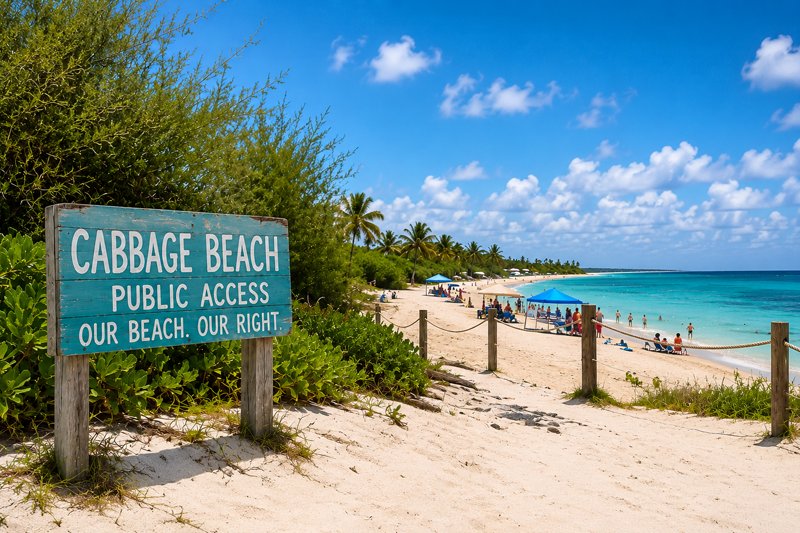
NASSAU, Bahamas — A fence erected at Cabbage Beach has been removed following concerns that it could restrict public access to one of New Providence’s best-known beaches and threaten the livelihoods of vendors, taxi drivers and watersports operators who depend on the area.
But while the fence may be gone, the controversy surrounding it touches a much older Bahamian question: Who gets access to the country’s beaches as valuable beachfront property is increasingly developed?
Freetown MP Wayne Munroe has said Cabbage Beach must remain accessible to Bahamians. The dispute once again places the competing interests of private property, resort development, tourism and traditional public access in the spotlight.
For many Bahamians, this is familiar territory.
From Paradise Island to Cable Beach and other heavily developed stretches of coastline, successive generations have watched beachfront land become increasingly valuable — often through developments that provide jobs, investment and substantial economic benefits. At the same time, those developments can create tension when traditional routes to beaches become less obvious, less convenient or disappear altogether.
That distinction is important. The debate is not necessarily about whether beaches themselves are privately owned. In The Bahamas, questions surrounding the high-water mark, private property and the practical means by which the public reaches the shoreline can be very different matters.
And therein lies the larger issue.
A beach that is technically available to the public is of little practical value if ordinary Bahamians cannot reasonably reach it.
The Cabbage Beach controversy also carries an economic dimension. Beach access supports an informal ecosystem of Bahamian entrepreneurship — taxi drivers, vendors, watersports operators and others whose livelihoods depend upon visitors and residents being able to reach the shore.
The Bahamas has spent decades balancing foreign investment with Bahamian ownership, participation and access. Hotels and resort developments have transformed the economy and created thousands of jobs. Yet the country’s beaches remain more than tourism inventory. They are part of the landscape through which Bahamians understand their country and themselves.
That is why a seemingly simple fence can generate such an emotional response.
The fence at Cabbage Beach came down.
The larger question — how The Bahamas protects meaningful public access to its coastline while continuing to encourage responsible development — remains standing.
IMAGE CREDIT: Illustrative AI image, not documentary photography of the actual Cabbage Beach dispute