NASSAU, Bahamas — For much of the modern history of The Bahamas, some of the country’s most important economic debates have revolved around a deceptively simple question:
Who controls the infrastructure on which the country depends?
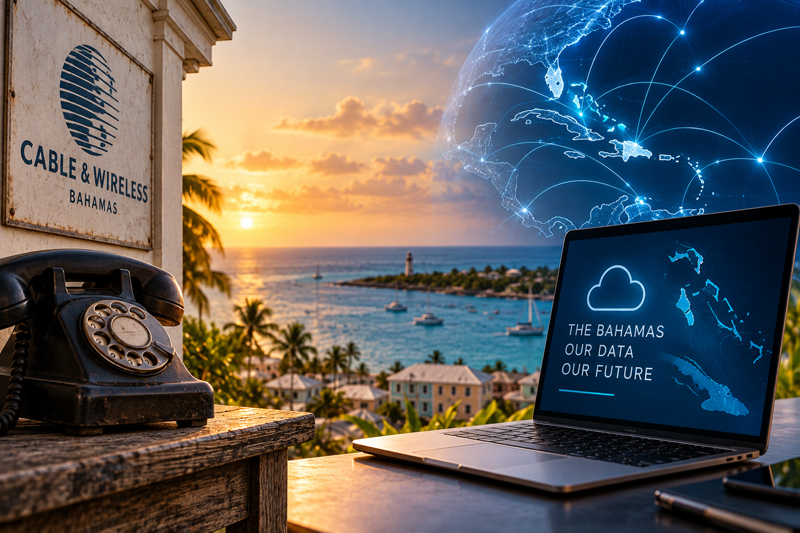
We asked it about telecommunications and Cable & Wireless. We asked it during the long debate over BTC and its eventual privatization. Similar questions have surrounded foreign-owned banks, electricity, utilities and other essential services.
Today, the infrastructure is changing.
The question isn’t.
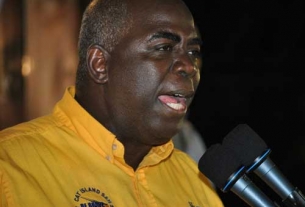
Prime Minister Philip Davis brought the issue into the digital age last week when he told an international telecommunications forum in Nassau that small island states must have a greater say in determining how their data and digital infrastructure are controlled.
The Bahamas, he argued, should not simply be connected to the digital world. It must have some control over the terms of that connection.
And increasingly, that means data.
The new infrastructure
Twenty years ago, national infrastructure meant telephone lines, power plants, banks, roads, ports and airports.
Today it also means cloud servers, undersea fibre-optic cables, data centres, artificial intelligence systems, payment networks and the databases containing everything from tax information and medical records to financial transactions.
The Bahamas may use those systems without actually controlling many of them.
That distinction matters.
A government database can contain Bahamian information while being hosted overseas. A Bahamian company can depend upon a foreign cloud provider. Critical communications can travel through infrastructure owned or operated by multinational companies.
In many respects, data has become the 21st-century equivalent of the telephone network, the bank and the power company.
Whoever controls the infrastructure holds considerable power over those who depend upon it.
We have been here before
Older Bahamians will recognize the argument.
For decades, the country wrestled with the balance between foreign investment and Bahamian control. Foreign companies brought capital, expertise and access to international markets that a small developing country could not always provide for itself.
But dependence came with questions.
Who set the prices? Who made the decisions? Where did the profits go? And what happened when the interests of the company and the interests of The Bahamas were not necessarily the same?
Those questions haven’t disappeared.
They have moved to the cloud.
The issue is not whether The Bahamas should reject international technology companies. That would be neither practical nor desirable.
The issue is whether Bahamians should understand — and have some meaningful authority over — where their information is stored, who can access it, which country’s laws govern it and what happens if an overseas provider changes its terms, raises its prices or simply goes offline.
There is an economic question as well.
Bahamian citizens and businesses generate enormous amounts of valuable data. Artificial intelligence will make that information more valuable still.
If the data originates here but the processing, intellectual property, technology, expertise and profits generated from it reside somewhere else, The Bahamas risks repeating a very old economic model in a remarkably modern form.
Ownership isn’t the only answer
Digital sovereignty does not necessarily mean government ownership.
The Bahamas does not have to build its own version of every cloud service, social network or artificial intelligence platform.
But it does need strong laws, capable regulators, cybersecurity protections, reliable backup systems and contracts that ensure the country is not helpless when something goes wrong.
For an archipelago vulnerable to hurricanes, resilience is particularly important.
Hurricane Dorian demonstrated that communications are not a luxury after a catastrophe. They are critical national infrastructure.
And as banking, commerce, government services and even taxation increasingly move online, losing digital connectivity can quickly become the modern equivalent of losing electricity.
The same old question
Technology changes remarkably quickly.
Questions of sovereignty do not.
The Bahamas once debated who should control the telephone company. It has debated foreign ownership of banks, utilities and other industries essential to national life.
The next debate may be less visible because the infrastructure isn’t necessarily sitting on Bay Street or connected to poles beside the road.
It may be sitting in a data centre thousands of miles away.
But the fundamental question remains remarkably familiar:
If an infrastructure becomes essential to the functioning of a country, how much control over it should that country surrender to someone else?
From Cable & Wireless to the cloud, The Bahamas is confronting an old question in a new form.
This time, the commodity isn’t simply telephone service, electricity or money.
It’s information.
And in the 21st century, information may prove to be the most valuable infrastructure of all.
BahamasB2B Analysis | Sept. 8, 2026