NASSAU, The Bahamas — By the headline numbers, Bahamian tourism has never been healthier.
The country welcomed a record 12.5 million visitors in 2025, the largest number in its history. It is an extraordinary achievement and one the Ministry of Tourism has understandably celebrated.
But look beneath that 12.5 million figure and a very different story begins to emerge.
The Bahamas received more than 10.7 million cruise visits in 2025, according to the Caribbean Tourism Organization, while the Ministry says there were only a little over 1.8 million stopover visitors.
In other words, the overwhelming majority of today’s visitors arrive aboard ships.
That wasn’t always the Bahamian tourism model.
When most tourists actually stayed here
In 1972, The Bahamas welcomed 1,036,210 stopover tourists and 407,191 cruise passengers.
Cruise passengers represented just 28 percent of visitors. Nearly three out of every four tourists stayed in The Bahamas.
Today, those proportions have essentially reversed.
The great reversal in Bahamian tourism
Visitor mix in 1972 compared with the approximate 2025 mix.
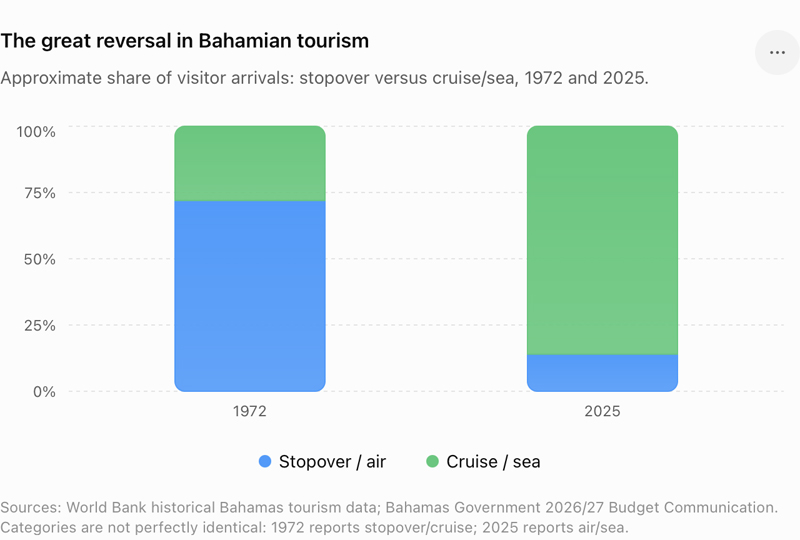
Sources: Ministry of Tourism historical statistics/World Bank; Bahamas Ministry of Tourism; Caribbean Tourism Organization. Modern and historical statistical categories are not perfectly identical.
That represents much more than a change in transportation.
It represents a fundamental change in the economics of Bahamian tourism.
A stopover visitor needs somewhere to sleep. Over five or seven days that visitor may eat a dozen or more meals, take taxis, rent a car, visit attractions, buy groceries, go fishing or diving, shop and spend money repeatedly throughout the Bahamian economy.
Cruise passengers certainly contribute as well. Cruise tourism supports jobs, excursions, restaurants, retailers, transportation businesses, port revenues and government taxes and fees. The Ministry estimated cruise tourism generated $654.8 million in direct expenditures during the 2023-24 cruise year, with total economic impact exceeding $1 billion when employment, taxes and levies were included.
But a cruise passenger and a seven-night hotel guest are not economically equivalent visitors.
A cruise passenger may spend a full day exploring Nassau.
Another might spend several hours inside a cruise port.
Another may visit a cruise line’s private destination.
And another may never leave the ship.
Yet each is counted as one visitor.
So is the tourist who flies into Nassau, checks into a hotel and spends a week in The Bahamas.
The arithmetic is correct.
The economic meaning of the arithmetic is considerably more complicated.
The number behind the record
There is another comparison that deserves attention.
The Ministry reported more than 1.8 million stopover visitors in 2025.
That means the stopover market — arguably the segment that spreads tourism spending most broadly through hotels and the surrounding economy — has grown far less dramatically than the headline 12.5 million figure suggests.
And that becomes particularly interesting when The Bahamas is compared with the region around it.
The Caribbean welcomed an estimated 35 million international stayover visitors in 2025.
More importantly, Caribbean stayover tourism was 16.7 percent above its pre-pandemic 2019 level.
That raises a question BahamasB2B believes deserves closer examination:
Why has Caribbean stayover tourism grown substantially beyond its 2019 level while the Bahamian stopover market has grown much more modestly?
That is not evidence that Bahamian tourism is failing.
Quite the opposite. The country has developed one of the world’s most successful cruise businesses.
But cruise growth has become so enormous that it can obscure the performance of the other side of the industry.
Some encouraging news in 2026
There are signs that this may be changing.
Through July 2026, The Bahamas recorded 1,314,639 stopover visitors — the strongest first seven months ever recorded.
Stopovers increased 4.3 percent over the same period in 2025. March, April, June and July all established monthly records. Canadian stopovers increased 15.4 percent and Latin American arrivals rose 16.4 percent.
Those are significant numbers.
Interestingly, the Ministry itself described stopovers in announcing them as the country’s “highest-value stopover segment,” whose spending supports businesses, jobs and economic activity throughout The Bahamas.
That distinction is important.
Because perhaps the most useful measurement of tourism isn’t simply how many people arrive.
It is how much economic activity their arrival creates.
Perhaps we need a better scoreboard
For decades, the Bahamian tourism industry’s scoreboard was closely connected to hotel occupancy.
Filled rooms meant restaurant meals, taxi rides, entertainment, shopping, tours, rental cars, fishing trips and money circulating among thousands of Bahamians employed directly or indirectly by tourism.
The modern tourism economy is different.
Cruise ships have become floating resorts in their own right. Cruise lines have invested heavily in private islands and destination experiences. Nassau’s cruise infrastructure has expanded dramatically, and additional cruise facilities are appearing throughout the archipelago.
The result is something The Bahamas should certainly celebrate: millions more people choosing The Bahamas as a destination.
But perhaps the country should stop allowing one giant arrival number to carry so much of the burden of describing the health of the industry.
Instead of merely counting visitors, why not place equal prominence on:
- Stopover arrivals
- Average length of stay
- Hotel occupancy and room revenue
- Average spending per visitor
- Spending with Bahamian-owned businesses
- Family Island visitor nights
- Tourism dollars retained within The Bahamas
Those figures would tell us something the 12.5 million number cannot:
How valuable is each visitor to the Bahamian economy?
Two very different tourism economies
In 1972, nearly three out of every four visitors to The Bahamas were stopover tourists.
Today, roughly seven out of every eight are cruise visitors.
The Bahamas can legitimately call both periods successful tourism eras.
But they describe two profoundly different tourism economies.
One was built primarily around bringing visitors into The Bahamas and accommodating them here.
The other increasingly brings enormous numbers of visitors to The Bahamas, sometimes for only a matter of hours.
The distinction shouldn’t diminish the extraordinary success of the country’s cruise industry.
It should encourage us to ask a better question.
Because the objective of tourism isn’t simply to move the greatest possible number of people across a Bahamian border.
It is to generate prosperity on the other side of that border.
So perhaps the question behind the celebrated 12.5 million figure isn’t:
How many people visited The Bahamas?
Perhaps it is:
How much of The Bahamas did they actually experience — and how much of their tourism dollar did The Bahamas actually receive?
BahamasB2B Analysis | September 2026
Editor’s note on the graphic: The historical and modern categories aren’t perfectly identical. The 1972 Ministry statistics distinguish stopover tourists from cruise passengers, while contemporary reporting uses several overlapping air, sea, stopover and cruise classifications. We’ve therefore labeled the chart as an approximate comparison rather than pretending the datasets are perfectly interchangeable. The historical reversal itself, however, is unmistakable.