By BahamasB2B
There is some genuinely good news in the latest Bahamian employment figures.
The national unemployment rate fell to 8.1 percent during the first quarter of 2026, down from 8.7 percent in the previous quarter. The number of unemployed Bahamians declined by 5.7 percent, to 20,240.
It was the third consecutive quarterly improvement in unemployment.
Those are numbers worth celebrating.
But there is another number buried inside the same Labour Force Survey that tells a considerably more complicated story.
There are now 29,085 underemployed Bahamians.
That number increased by 2,890 people — or 11 percent — in just one quarter.
And when those 29,085 underemployed workers are added to the 20,240 Bahamians who are unemployed, something remarkable emerges.
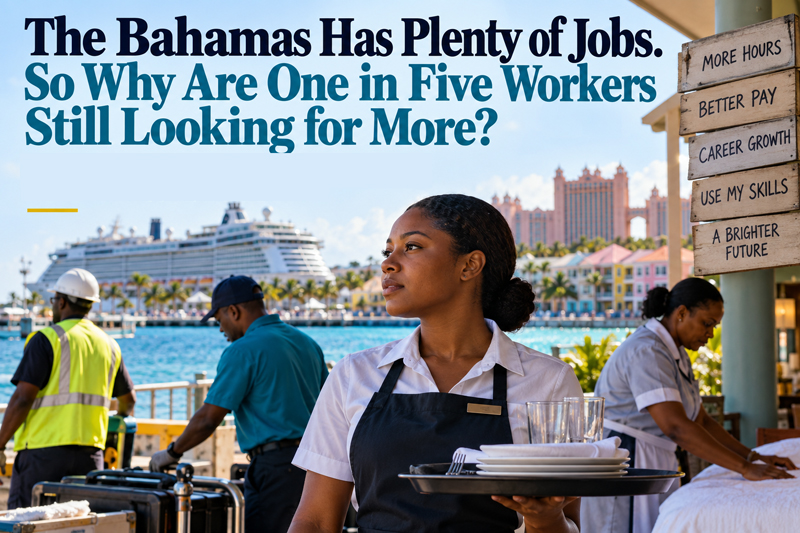
49,325 people in a labour force of 249,025 are either unemployed or underemployed.
That’s 19.8 percent.
Almost exactly one in five.
Having a Job Isn’t Necessarily the Same as Having Enough Work
“Underemployment” is an important word here.
These aren’t people sitting at home without jobs.
They are working.
The Bahamas National Statistical Institute defines underemployed people as employed individuals whose jobs don’t provide the compensation or working hours they want, or don’t adequately use their skills and experience, and who are seeking or available for additional work.
Think about what that means in real life.
It can be the hotel employee who wants five days of work but regularly gets three.
The university graduate working in a position that requires none of his or her qualifications.
The experienced worker who has accepted a lower-paying position because it was the only one available.
The person working two jobs because neither one alone provides sufficient income.
They count as employed.
And statistically, they should.
But economically, their experience can be very different from what most people imagine when they hear that “employment is up.”
That distinction matters.
Meanwhile, The Bahamas Is Breaking Tourism Records
The employment figures become even more interesting when placed beside another set of Bahamian statistics.
In 2025, The Bahamas welcomed a record 12.5 million visitors, an 11.4 percent increase over 2024 and more than 70 percent above the pre-pandemic 2019 level.
That’s an extraordinary achievement for a country of our size.
And tourism continues to generate enormous economic activity throughout the islands.
But there is an important qualification.
Of those 12.5 million visitors, only about 1.7 million arrived by air. The overwhelming majority of the remainder arrived by sea.
That distinction matters because not every visitor contributes equally to the Bahamian economy.
A stopover visitor who spends several nights in a Bahamian hotel buys accommodation, meals, drinks, taxis, entertainment, excursions and perhaps groceries and retail goods.
A cruise passenger may spend considerably less ashore — and increasingly may spend part or all of the visit at a cruise line’s own private destination.
So when we announce another record year for tourism, the most important question should no longer be simply:
How many visitors came?
It should also be:
How much economic opportunity did each visitor leave behind?
And, ultimately:
How much of it reached Bahamian workers?
The Numbers May Be Telling Us Something
The Bahamas has spent generations building one of the Caribbean’s most successful tourism economies.
We have built enormous hotels, expanded airports, welcomed cruise ports, attracted billions of dollars in foreign investment and repeatedly broken visitor-arrival records.
All of that creates employment.
The falling unemployment rate suggests that job creation is indeed taking place.
But the simultaneous rise in underemployment raises a different question:
What kind of jobs are we creating?
That may ultimately be more important than simply counting them.
A country can theoretically have very low unemployment while still having large numbers of citizens struggling financially.
If workers cannot obtain enough hours, if wages do not keep pace with living costs, if skilled people are routinely working below their qualifications, or if too much employment remains casual or precarious, then “job creation” alone does not tell us everything we need to know about the health of the economy.
There is an enormous difference between creating a job and creating a career.
Then There Is the Skills Question
Employers in The Bahamas have complained for years that they cannot find enough Bahamians with the skills required for particular positions.
Workers, meanwhile, frequently complain that good jobs are unavailable — or that positions they could fill are instead given to foreign workers.
Those two statements can actually be true at the same time.
The problem may be a mismatch.
A modern economy doesn’t simply need workers. It needs the right workers with the right skills in the right places.
Hotels need increasingly sophisticated technical, managerial, digital and financial talent.
Construction requires skilled trades.
Financial services requires specialized qualifications.
Technology increasingly touches almost every industry.
The maritime and aviation sectors need highly trained workers.
And the transition toward renewable energy will create entirely new categories of technical employment.
If thousands of Bahamians are looking for better work while employers are simultaneously looking outside the country for particular skills, then the problem isn’t simply unemployment.
It is alignment.
Training, education and immigration policy therefore cannot be discussed independently of one another.
The objective shouldn’t be to eliminate foreign workers. No modern economy operates that way.
The objective should be to ensure that whenever possible, Bahamians have a realistic pathway to acquire the qualifications necessary to compete for the better jobs being created inside their own economy.
The Middle of the Economy Matters
For decades, Bahamian economic policy has understandably focused heavily on attracting investment and creating employment.
Perhaps the next stage requires a slightly different measurement.
Not simply:
How many jobs did this development create?
But:
How many are full-time?
How many pay enough to support a household?
How many provide benefits?
How many include training?
How many offer advancement?
How many are supervisory or managerial?
How many develop skills that a Bahamian worker can carry into the next job?
And how many can reasonably become careers?
Those aren’t arguments against tourism, foreign investment or economic development.
They are arguments for getting more value from them.
8.1 Percent Is Good News. But It Isn’t the Whole Story.
The Government is right to welcome a falling unemployment rate.
Businesses should welcome it too.
More Bahamians working is unquestionably better than fewer Bahamians working.
Labour Minister Pia Glover-Rolle has also acknowledged the other side of the equation, saying the Government takes the underemployment figures seriously and wants Bahamians qualified not merely for jobs, but for higher-paying jobs and long-term careers.
That may be the more important challenge.
The Bahamas has demonstrated repeatedly that it knows how to attract tourists.
It has demonstrated that it can attract enormous foreign investments.
It has demonstrated that it can create jobs.
The next test is harder.
Can we turn more of those jobs into prosperity?
Because an economy shouldn’t ultimately be judged by how many people have somewhere to report at 9 o’clock in the morning.
It should be judged by whether working people can build a life from the work they do.
And when nearly one in every five people in the Bahamian labour force is either unemployed or saying, in effect, “I need more,” that is a statistic worth paying attention to.
Especially when everything else appears to be booming.