The Caribbean Vacation Business Is Converging
Royal Caribbean’s $3 billion investment in Sandals is much more than a hotel deal. It may tell us where Caribbean tourism is headed—and why countries like The Bahamas need to think differently about who ultimately receives the tourism dollar.
NASSAU, The Bahamas — For decades, Caribbean tourism has been divided into two fairly distinct businesses.
There were cruise passengers.
And there were hotel guests.
One arrived aboard a floating resort, spent several hours ashore and sailed away.
The other flew in, checked into a hotel and stayed for several nights.
Governments counted them separately. Tourism ministries marketed to them differently. Hotels and cruise lines frequently competed for the same vacation dollar.
That distinction suddenly looks considerably less clear.
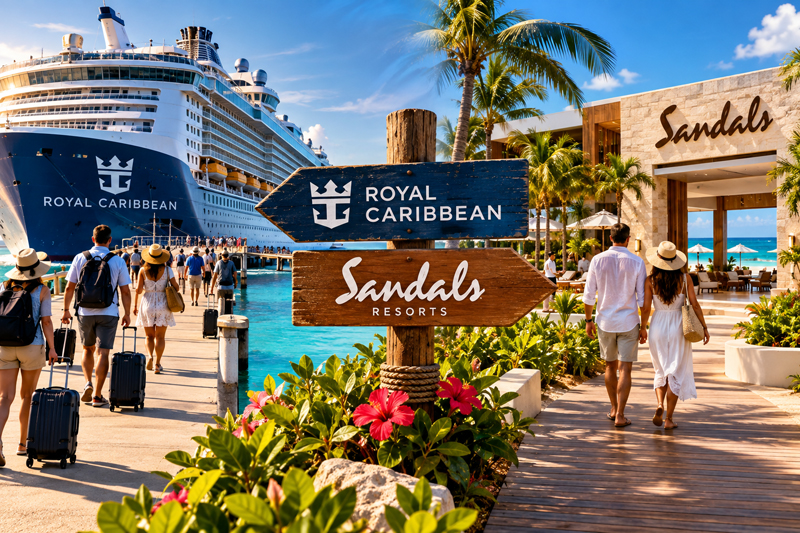
Royal Caribbean Group has agreed to spend approximately $3 billion for a 50 percent interest in Sandals and Beaches Resorts, one of the Caribbean’s most recognizable land-based tourism companies.
The transaction is expected to close in early 2027, subject to regulatory approvals and other customary conditions. The Stewart family will retain the other half, and Sandals Executive Chairman Adam Stewart will continue playing a leadership role. U.S. Securities and Exchange Commission
Think about what just happened.
One of the world’s largest cruise companies is buying half of one of the Caribbean’s best-known hotel companies.
That deserves considerably more attention in The Bahamas than simply another headline about a corporate acquisition.
Because Royal Caribbean may be telling us something important about the future of the Caribbean vacation.
They aren’t calling themselves just a cruise company anymore
Royal Caribbean’s own announcement is revealing.
The company describes a vacation platform encompassing Royal Caribbean International, Celebrity Cruises and Silversea, along with private destinations, its developing river-cruise business and now the Sandals and Beaches resort portfolio.
The company says the Sandals investment broadens that vacation platform and creates opportunities to distribute vacation experiences across the two businesses. U.S. Securities and Exchange Commission
That language matters.
Royal Caribbean isn’t merely trying to sell more cruises.
It increasingly wants to sell vacations.
And there is a considerable difference between the two.
The old tourism model
For much of modern Bahamian tourism history, the economic chain was relatively easy to understand.
An airline brought the visitor.
A hotel housed the visitor.
A taxi driver moved the visitor.
A restaurant fed the visitor.
A tour operator entertained the visitor.
A retailer sold something to the visitor.
Different businesses captured different pieces of the tourism dollar.
Cruise tourism operated differently.
The cruise company provided the transportation, accommodation, meals and entertainment.
Once the passenger stepped ashore, however, Bahamian businesses had an opportunity to compete for some of the remaining spending.
Taxi drivers.
Straw vendors.
Restaurants.
Tour operators.
Dive companies.
Boat excursions.
Retail stores.
That model is changing.
The cruise line comes ashore
Modern cruise companies increasingly own or control more of the destination experience.
Royal Caribbean has developed a growing portfolio of private destinations. Its corporate description now explicitly places those destinations alongside its cruise brands as part of the company’s broader vacation business. U.S. Securities and Exchange Commission
Other cruise companies are following similar strategies across the Caribbean.
The logic is straightforward.
Why earn money only while the passenger is aboard the ship if you can also participate in what that passenger spends ashore?
That can produce extraordinary destination experiences for travelers and substantial investment for host countries.
But economically it raises an important question.
How much of the visitor’s spending ever leaves the tourism ecosystem controlled by the company that brought the visitor?
Now Royal Caribbean is taking that logic considerably further.
It isn’t merely moving from the ship onto the beach.
It is moving into the hotel.
Enter Sandals
Sandals is not a minor hotel operator.
Founded by Gordon “Butch” Stewart in Jamaica in 1981, the company built one of the Caribbean’s most recognizable tourism brands around the all-inclusive vacation.
Today Sandals and Beaches comprise 20 resorts across the Caribbean. Royal Caribbean says the investment is intended to accelerate expansion of those brands and broaden distribution across the two companies’ customer bases. Reuters
And The Bahamas is very much part of that story.
Sandals operates Sandals Royal Bahamian in Nassau. Its former Sandals Emerald Bay property in Exuma closed in 2024 for conversion into a Beaches family resort. Sandals Resorts
So this isn’t some distant Wall Street transaction involving companies that happen to operate elsewhere in the Caribbean.
One of the world’s largest cruise companies is about to become a major investor in a resort business with significant Bahamian interests.
Cruise or stopover?
This makes our recent BahamasB2B discussion about tourism statistics even more interesting.
We recently asked what lies beneath The Bahamas’ record 12.5 million visitor arrivals.
The overwhelming majority are cruise passengers.
Stopover visitors represent a much smaller share, even though they generally create a broader range of economic activity because they need accommodations, meals, transportation and entertainment over several days.
We have traditionally treated increasing stopovers as one way to diversify away from an excessive dependence on cruise tourism.
But what happens when the cruise company also owns the hotel company?
Suddenly our familiar categories begin to blur.
A customer could encounter Royal Caribbean while considering a cruise.
That same customer could instead be marketed a Sandals vacation.
Another might combine a cruise with several nights at a resort.
A Celebrity customer could become a Sandals customer.
A Sandals customer could become a Royal Caribbean customer.
Royal Caribbean has specifically said the partnership will explore broader distribution and ways to make it easier for travelers to discover experiences across both portfolios. RCCL Investors –
From the company’s perspective, that’s smart business.
If the traveler decides against a cruise, why lose the traveler?
Sell him a resort vacation instead.
But where does The Bahamas fit?
This is where Bahamian policymakers should pay close attention.
For years we have concentrated heavily on how many tourists arrive.
Perhaps the next generation of tourism policy needs to concentrate much more heavily on who owns the businesses receiving their money.
Imagine a visitor’s vacation dollar.
An international company sells the vacation.
Another international company provides the transportation.
An international hotel houses the visitor.
The visitor eats meals included in the resort package.
Activities are purchased through the resort.
Transportation is arranged through the resort.
The beach experience is part of the resort.
Even loyalty points encourage the visitor to remain within the same corporate family on the next vacation.
The tourist can have a wonderful Bahamian holiday while surprisingly little of his discretionary spending ever reaches an independent Bahamian business.
That is not an accusation against Royal Caribbean or Sandals.
It is simply the economics of vertical integration.
And it is hardly unique to tourism.
Companies in virtually every industry try to control more of the relationship with their customers.
The Caribbean vacation industry is increasingly doing the same thing.
From hotel room to ecosystem
The all-inclusive resort was itself an earlier version of this idea.
Instead of allowing the guest to decide each morning where to eat, drink or spend the day, the hotel bundled those decisions into the price of the vacation.
That proposition became enormously successful.
The cruise ship took the idea even further.
Accommodation.
Food.
Bars.
Entertainment.
Shopping.
Casino.
Swimming pools.
Children’s activities.
Excursions.
Transportation between destinations.
All wrapped into one controlled vacation ecosystem.
Now those ecosystems are beginning to merge.
Royal Caribbean says its Sandals investment gives it greater participation in what it describes as the approximately $2 trillion global vacation market. Cruise Industry News | Cruise News
That phrase may tell us more than anything else in the announcement.
The target isn’t the cruise market.
It isn’t the hotel market.
It’s the vacation market.
The Bahamas helped invent Caribbean tourism
There is an interesting historical perspective here.
The Bahamas was one of the early pioneers of modern Caribbean resort tourism.
Nassau and Freeport developed international reputations long before many destinations that compete aggressively with us today.
The old model brought visitors into communities.
They stayed at hotels, but they also ventured outward.
Bay Street.
The Straw Market.
Restaurants.
Nightclubs.
Casinos.
Taxi tours.
Fishing guides.
Dive operators.
Local shops.
In Freeport, the International Bazaar and surrounding tourism economy were designed around visitors spending days on the island.
The tourism dollar moved through many hands.
Over time, tourism became more self-contained.
First larger resorts.
Then all-inclusives.
Then increasingly sophisticated cruise ships.
Then private cruise destinations.
Now we are watching the corporate structures behind those different vacation models begin to converge.
The question isn’t whether that evolution should be stopped.
It probably can’t be.
The question is how The Bahamas prospers within it.
Bigger companies aren’t necessarily bad for The Bahamas
There are obvious advantages to scale.
Royal Caribbean possesses enormous marketing reach, customer data, capital and distribution.
Sandals possesses decades of Caribbean resort expertise and an internationally recognized brand.
Together they may attract visitors who otherwise would vacation elsewhere.
They may develop new properties.
They may create jobs.
They may buy Bahamian goods and services.
They may expand airlift.
And a stronger Sandals or Beaches product could increase The Bahamas’ ability to compete internationally.
The companies themselves say the partnership is intended to accelerate resort growth while creating broader opportunities for travelers. Royal Caribbean Group Press Center
None of that should be dismissed.
But attracting tourism investment and maximizing the Bahamian benefit from tourism investment are not necessarily the same thing.
Follow the dollar
Perhaps Bahamas tourism statistics need another column.
Not merely: How many visitors came?
Not merely: Did they arrive by air or sea?
But: Where did their money go?
How much stayed in The Bahamas?
How much went to wages?
How much went to Bahamian suppliers?
How much reached independent restaurants, shops, taxis and excursion operators?
How much left the country through imported food, international management fees, debt payments, overseas booking platforms and corporate profits?
And how much economic activity occurred outside the walls—or beaches—of the visitor’s chosen tourism ecosystem?
Those numbers would tell us considerably more about tourism’s value than an arrival counter at the border.
Bahamian businesses need access to the ecosystem
If tourism is becoming increasingly integrated, Bahamian businesses must become integrated too.
That doesn’t necessarily mean competing against giant tourism corporations.
Often it means becoming indispensable suppliers to them.
Bahamian farmers supplying hotels.
Bahamian fishermen supplying restaurants.
Bahamian artists supplying rooms and galleries.
Bahamian musicians providing entertainment.
Bahamian excursion companies appearing prominently on booking platforms.
Bahamian technology companies providing services.
Bahamian manufacturers producing amenities and products.
Bahamian chefs and restaurateurs gaining access to visitors.
The objective should be simple:
If the tourism ecosystem becomes larger, the Bahamian presence inside that ecosystem should become larger with it.
Otherwise record visitor numbers can coexist with Bahamians wondering where all the tourism money went.
The customer has changed too
There is another reason Royal Caribbean’s move makes sense.
Travelers increasingly don’t define themselves permanently as “cruise people” or “hotel people.”
The same couple might take a Royal Caribbean cruise this year, spend a week at Sandals next year and choose a luxury Celebrity voyage the year after that.
From the traveler’s perspective, these aren’t competing industries.
They’re vacations.
Royal Caribbean has apparently reached the same conclusion.
That makes the Sandals deal less surprising than it first appears.
Perhaps the real surprise is that it took this long.
The next tourism question
For The Bahamas, the transaction should cause us to reconsider an old assumption.
For decades we’ve debated:
Cruise tourism or stopover tourism?
Perhaps that is becoming the wrong question.
The businesses themselves increasingly don’t see such a rigid distinction.
Royal Caribbean is investing in ships, destinations and resorts because it wants a relationship with the traveler regardless of which vacation that traveler chooses.
The Bahamas should think just as broadly.
Our objective cannot simply be maximizing cruise passengers.
Nor should it simply be maximizing hotel guests.
It should be maximizing the economic value tourism creates for Bahamians.
That means understanding who owns the infrastructure, who employs the workers, who supplies the resorts, who sells the excursions, who processes the bookings—and ultimately where the visitor’s dollar ends up.
Because the Caribbean vacation business is changing.
The cruise company is coming ashore.
The resort company is becoming part of a global vacation platform.
And the lines separating cruise passenger from hotel guest are beginning to disappear.
The Bahamas should make certain one line doesn’t disappear with them:
the line connecting the visitor’s wallet to the Bahamian economy.
BahamasB2B Analysis | September 2026