The Bahamas is right to defend its sovereignty. But in the fight against international drug trafficking, there is another uncomfortable question: whom can the United States safely trust?
NASSAU, The Bahamas — Attorney General Wayne Munroe makes an argument that is difficult to dispute.
American law-enforcement officers should not simply conduct operations in an independent Bahamas as though the country were an extension of South Florida.
The Bahamas has laws. It has borders. It has sovereignty.
And 53 years after independence, that sovereignty deserves respect.
But that cannot be the end of the conversation.
The growing dispute over undercover U.S. Drug Enforcement Administration operations in The Bahamas raises another question—one considerably more uncomfortable for Bahamians:
What happens when informing local authorities may compromise the investigation itself?
That isn’t merely hypothetical.
A troubling recent history
In November 2024, U.S. federal prosecutors charged 13 people in an alleged cocaine-importation conspiracy involving The Bahamas.
Among those charged were a chief superintendent of the Royal Bahamas Police Force and a chief petty officer of the Royal Bahamas Defence Force.
U.S. prosecutors alleged that corrupt Bahamian officials helped protect large cocaine shipments moving through The Bahamas toward the United States. The allegations remain subject to the judicial process, but the indictment itself revealed the extraordinary challenge confronting international drug investigators. Justice Department
If an investigation potentially involves members of the institutions with whom investigators would normally share information, how much information can safely be shared?
That is the elephant in the room.
An old problem
There is something almost eerie about today’s dispute.
In January 1980, Prime Minister Sir Lynden Pindling complained to American diplomats about alleged improprieties in DEA activities in The Bahamas.
Declassified U.S. State Department records show Washington subsequently reviewed the allegations with the DEA and Florida law-enforcement authorities. Office of the Historian
The cocaine era subsequently transformed The Bahamas.
Its hundreds of islands and cays, enormous territorial waters and proximity to Florida made the country enormously attractive to traffickers moving narcotics from South America into the United States.
The answer eventually became cooperation.
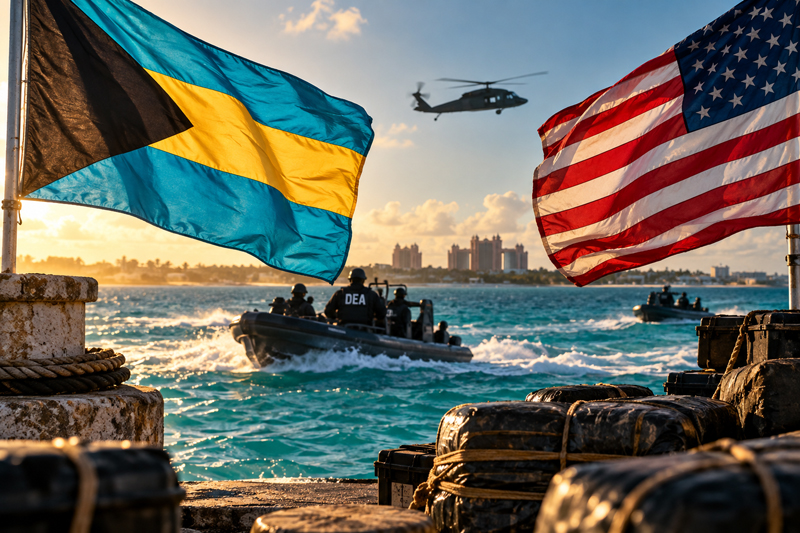
Operation Bahamas, Turks and Caicos—OPBAT—was established in 1982 and became one of the world’s longest-running international counternarcotics partnerships. DEA, U.S. Coast Guard and Bahamian authorities have worked together for decades intercepting drugs and pursuing traffickers. State Department
That partnership has accomplished a great deal.
But cooperation depends upon something treaties cannot manufacture: trust.
The sovereignty argument
Munroe argues that undercover American officers should operate with reference to Bahamian law enforcement.
His analogy is straightforward: Bahamian police could not simply travel to Miami, conduct undercover drug transactions and ignore American authorities.
He’s right about the principle.
The Bahamas cannot surrender sovereignty merely because the United States has greater resources, better intelligence capabilities or a larger interest in stopping drugs destined for American streets.
But sovereignty imposes responsibilities as well as rights.
A sovereign nation must demonstrate that its institutions can be trusted with highly sensitive investigations—particularly investigations that might involve people with political connections or members of the security services themselves.
That is where the present controversy becomes more complicated.
Imagine the DEA’s dilemma
Suppose American investigators receive credible information that a major cocaine shipment will pass through The Bahamas.
Ordinarily, they contact their Bahamian counterparts.
But suppose the intelligence also suggests that someone inside the Bahamian law-enforcement apparatus may be protecting the traffickers.
Who gets told?
The Commissioner?
A special unit?
A minister?
The Attorney General?
And how many people can know before the investigation itself is endangered?
Those aren’t accusations against any particular person.
They are basic questions of counter-narcotics intelligence—and recent U.S. indictments demonstrate that the possibility of institutional compromise cannot simply be dismissed. Justice Department
America has responsibilities too
None of this gives Washington unlimited authority.
American agents operating overseas must respect the legal arrangements under which their presence is permitted. The United States and The Bahamas already have extensive mechanisms for cooperation, including OPBAT and a comprehensive maritime agreement governing joint counternarcotics operations. U.S. Department of State
If American officers exceeded those arrangements, The Bahamas has every right to demand an explanation.
The answer, however, shouldn’t become a contest between American power and Bahamian pride.
The objective is stopping cocaine.
And that requires acknowledging an uncomfortable reality on both sides.
The United States is the enormous consumer market that makes Caribbean drug trafficking extraordinarily profitable.
The Bahamas, because of geography, sits along the road to that market.
America therefore cannot simply lecture its neighbours about a drug trade fueled substantially by American demand.
But The Bahamas cannot insist upon complete operational visibility while refusing to confront the possibility that corruption within its own institutions may sometimes make complete visibility dangerous.
Trust must be earned
The Bahamas and the United States have been fighting this battle together for more than four decades.
Neither country benefits from turning that relationship into a diplomatic shouting match.
The answer should be stronger safeguards: tightly vetted joint teams, restricted intelligence compartments, auditable authorization procedures and clear rules establishing when exceptionally sensitive information can be withheld—and from whom.
That protects Bahamian sovereignty without pretending institutional corruption can never exist.
Because ultimately this isn’t an argument about whether The Bahamas is sovereign.
It unquestionably is.
Nor is it an argument about whether American agents should obey Bahamian law.
They should.
The harder question is whether sovereignty automatically entitles every part of a government to know everything a foreign partner discovers during an investigation.
Recent history suggests the answer cannot always be yes.
For The Bahamas to demand America’s trust is entirely reasonable.
But trust isn’t something one sovereign government can demand from another.
It is something institutions earn.
BahamasB2B Analysis | September 2026